


#128 – Unprocessed Foods: The Ancestral Pantry
What foods will you find in an ancestral pantry in a modern world kitchen? Today we will share some of the foods we store in our pantries to keep our regional, from-scratch meals on the table on a daily basis, as well as talk about modern tools that help us to turn some inexpensive, bulk raw products into value-added products. We will travel back in time to visit ancient and old pantries and look at what people were eating and how they were storing it, and we will also talk about ancient tools, some of which we still use today.
Supporters of the pod can check their private podcast feed for an aftershow where we share some of the foods we used to keep in our pantries “Before” ancestral food; and, everyone can check the show notes here for some of our favorite resources for reading about pantries and food in times past.
* * * * * * * * * * * * * * * * * * * * * * * * * *
Get more news from Alison & Andrea by signing up to their newsletter at the top of this page.
For more tips, inspiration and recipes, plus a free 30-page guide: Baking with Ancient Grains sign up for Alison’s newsletter here!
Get our two podcast cookbooks:
Alison’s course, Rye Sourdough Bread: Mastering The Basics
Alison’s Sowans oat fermentation course
Get 10% off US/Canada Bokashi supplies: click here and use code AKP.
Get 10% off UK Bokashi supplies.
Visit our (non-Amazon!) bookshop for a vast selection of ancestral cookbooks: US link here and UK link here.
* * * * * * * * * * * * * * * * * * * * * * * * * *
Our podcast is supported by ancestral cooks around the world!
Come join our community! You can choose to simply sponsor the podcast, or select from a variety of levels with benefits including monthly live Zoom calls, a private podcast feed stuffed with bonus content from Alison and Andrea, and a Discord discussion group.
To read more about becoming a supporter and explore the various levels, click here!
* * * * * * * * * * * * * * * * * * * * * * * * * *
* * * * * * * * * * * * * * * * * * * * * * * * * *
We love 5* reviews on apple podcasts!
If you love the show here’s how to leave one:
- Open the Apple Podcast app
- Find Ancestral Kitchen Podcast in your library
- Scroll down to ‘ratings and reviews’
- Click on ‘write a review’, choose 5*s then let us know why you love us in the lower box.
Thank you. We really appreciate you taking the time to support us!
* * * * * * * * * * * * * * * * * * * * * * * * * *
Resources:
For the photos and descriptions mentioned in the show, see our show notes at www.ancestralkitchenpodcast.com
Ruth Goodman video, “What the Tudors really ate”
Food in History, Reay Tannahill
Five Children and It, E. Nesbit
The Diary of a Farmer’s Wife 1796 – 1797, Anne Hughes
Food In England, Dorothy Hartley
Lost Country Life, Dorothy Hartley
The Domestic Revolution, Ruth Goodman
* * * * * * * * * * * * * * * * * * * * * * * * * *
Do you have memories, documents, recipes or stories of those who cooked ancestrally? If so, we would love to hear from you! Visit our website here for how to share.
Thank you for listening – we’d love to connect more:
The podcast has a website here!
Alison is taking a break from Instagram. You can stay in touch with her via her newsletter at Ancestral Kitchen
The podcast is on Instagram at Ancestral Kitchen Podcast
The podcast is mixed and the music is written and recorded by Alison’s husband, Rob. Find him here: Robert Michael Kay
* * * * * * * * * * * * * * * * * * * * * * * * * *
- In Diary of a Farmer’s Wife: 1796 – 797, Anne Hughes writes of “Disturbances in the Larder”. After going to bed at 6:00PM, Anne and her husband John are awakened by John’s mother, who says she heard “A noise in the kitchen.” John rousts himself, and eventually the whole family is up and searching, and Anne says: “We did see nought in the kitchen, but Sarah going to the larder did cry out for us to go and see; and we in and did see the meat be all gone from the plate, with only sum scrappie bittes left. We all verrie scared at this, and John did look to the winder, and we all amazed to find it be still barred inside, and the bolt in place. Then says John’s mother someboddie be here for sure, so we to the searching of the house; but did find nought, every place being the same as when we did go to bed overnite… I was verrie pusselled for somebody did eat the ham, but we know not who or how.” (114)
- Bread Corn, from Dorothy Hartley’s Lost Country Life (1979)
Make suer of bread-corn (of all other grain),
lie dry and well look’d to, for mouse and for rain;
Though fitches and pease, and such other as they,
(for pestering too much) on a hovell ye lay.
With whins or with furzes, thy hovell renew,
for turf and for sedge, for to bake and to brew;
For charcoal and sea-coal, and also for thack,
for tall-wood and billet, as yearly ye lack.
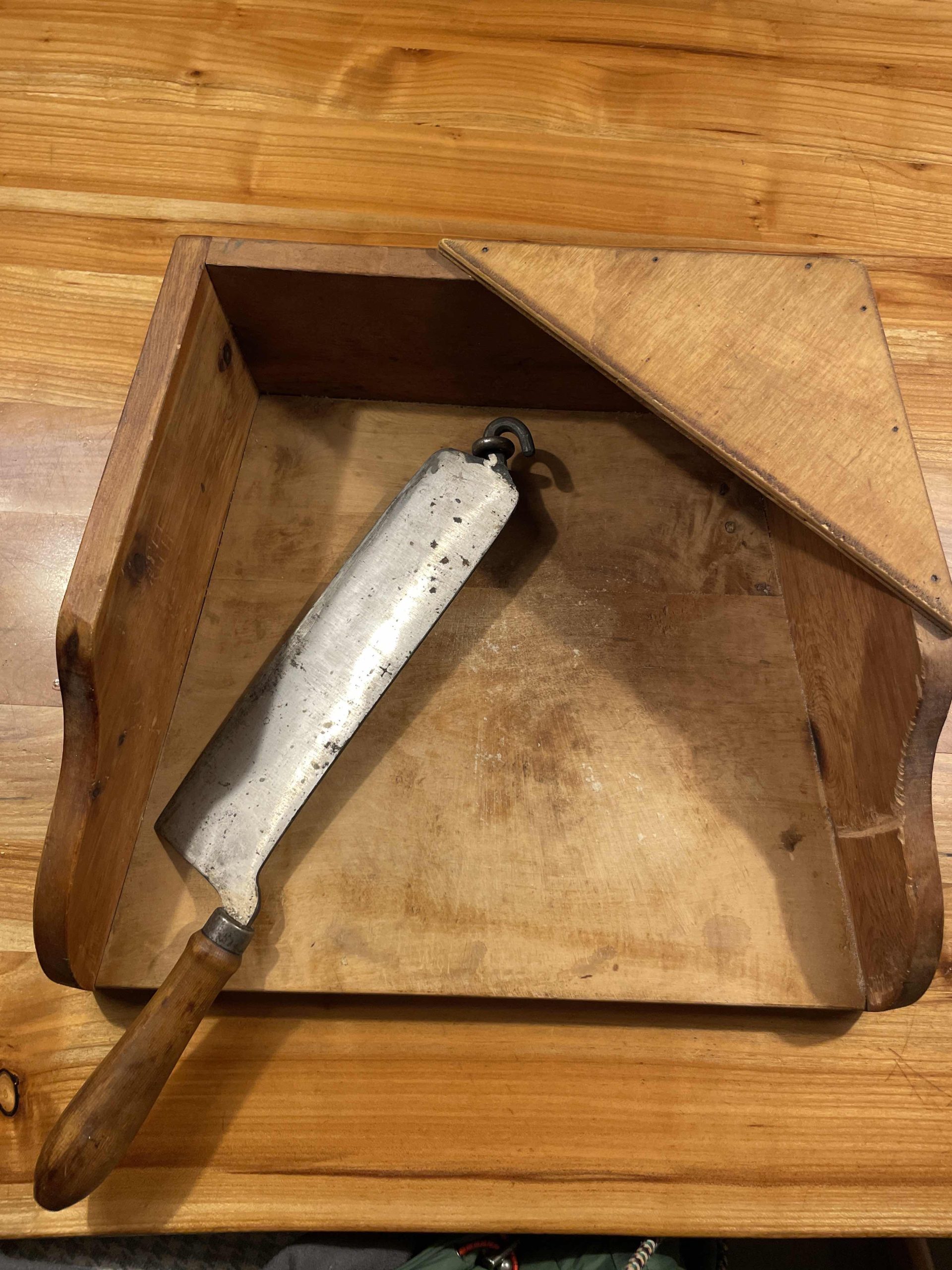
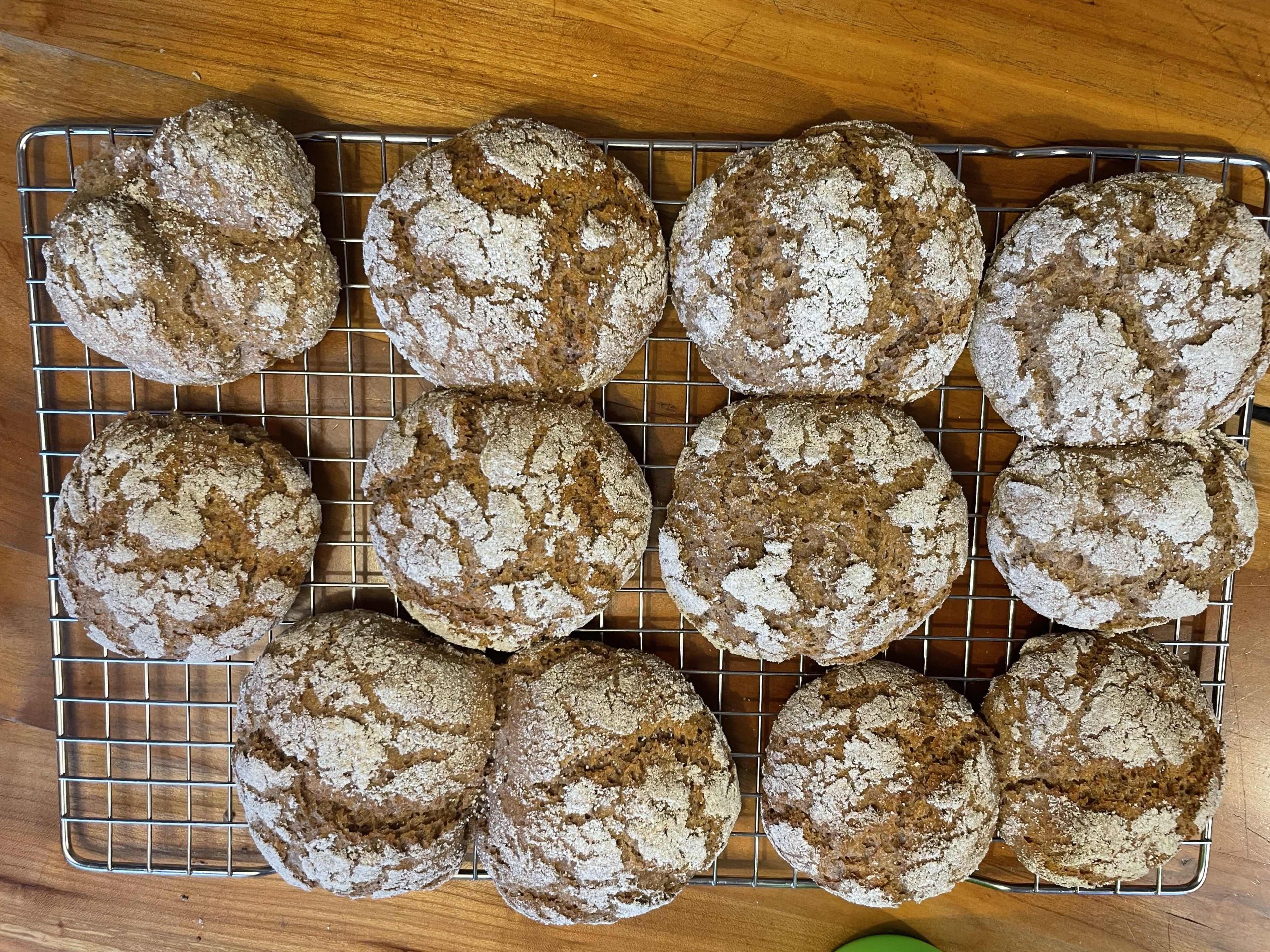
- Nicole’s description of her ancestral bread slicer – see pictured round loaves
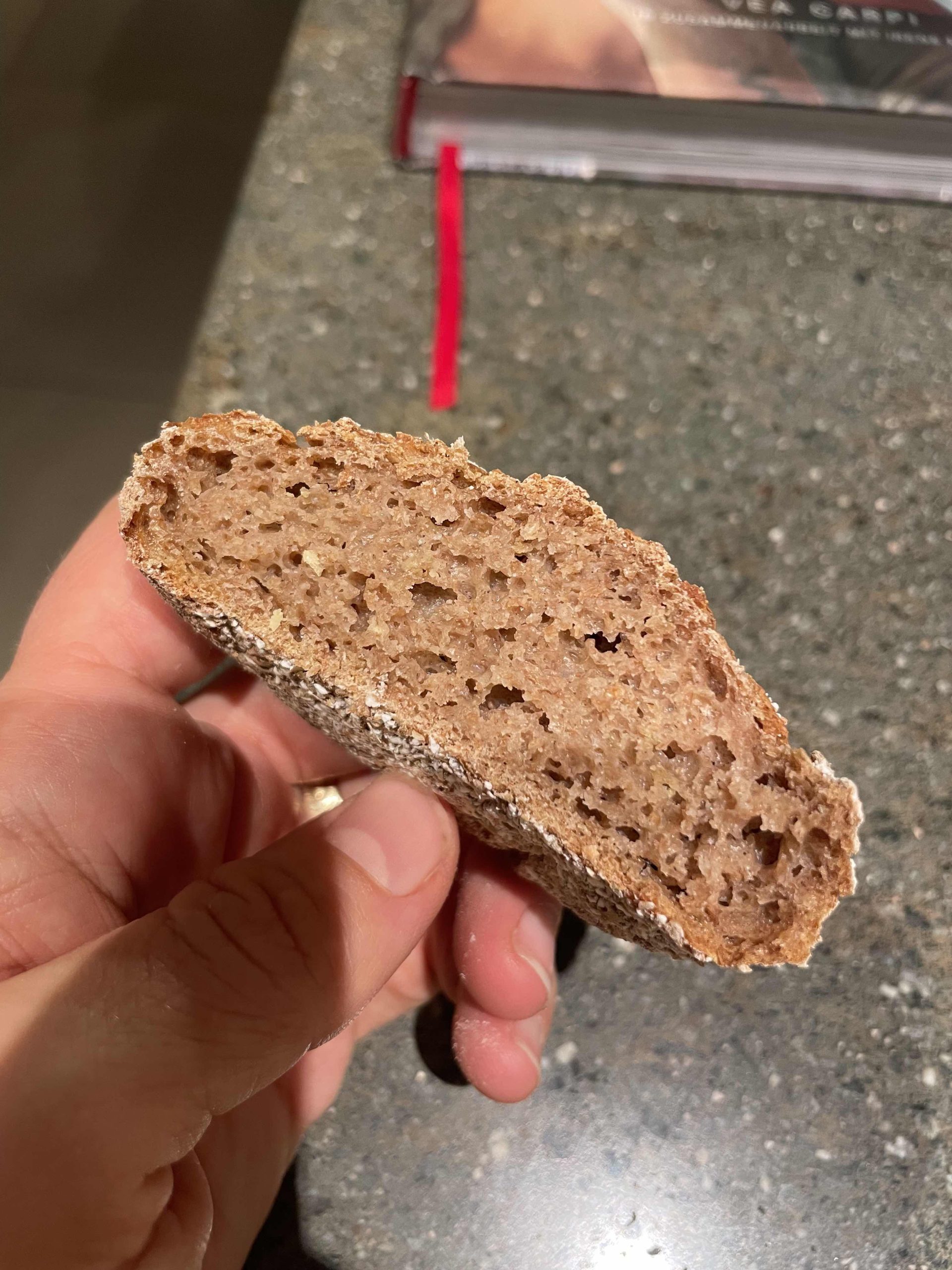
These are called „Vinschger Paarlen“. Vinschgau is a valley close by and Paarl means pairs. Most of them are connected in the middle. Traditionally they are made with rye and sourdough in a specific bread trough as well as typical local herbs like blue fenugreek. A large batch of dough would have been made and on the local farms the bread oven would be fired up. Then all day the bread was made. Some were eaten fresh but most of them would have been dried on racks that were put above the heat source in the communal living area. Then a „Grommel“ was used to chop up the hard bread. This hard bread was a staple for the family and would be often eaten at least once or twice a day. My Oma and Opa would always drop pieces of the bread into their coffee, wait for them to soften and then eat them with a large spoon. A pat of butter and often some jam were on the table in bowls as well. You‘d take a spoonful of coffee soaked bread and put that in your mouth but not yet start chewing. Then dip the same spoon into the butter and then into the jam so as to have both on your spoon and then pop that into your mouth and only then would you chew and savor all the flavors. Nowadays its hard to find fully whole wheat rye „Vinschger“ as often white rye flour will be added in. And almost always they are made with bakers yeast, sometimes there might be a portion of sourdough in them. I‘ve been wanting to try to recreate them using Alison Kay’s recipe for everyday rye bread with adjustments of course. I finally tried it and it worked!!! So excited.
- How does the slicer work?
Because the bread is so hard it’s difficult to cut. That is why the knife is attached to the board. You wedge a piece of bread under the knife and then that works as extra leverage to help chop. The chopped bits you then slide to the right in the covered corner.
* * * * * * * * * * * * * * * * * * * * * * * * * *
Transcript:
Alison:
Hello, Andrea.
Andrea:
Hello, Alison. How are you today?
Alison:
I’m doing okay. How’s your voice this morning? Yeah, it’s touch and go. It’s okay. As long as I don’t start coughing, then it’s not okay. So we’ll see how it goes this morning. Rob might have to cut out the odd cough. We’ll see. How about you? How are you?
Andrea:
I’m doing well. You know, it’s interesting thinking about how much we record, how actually very few interruptions we’ve had for lack of voice it’s actually now now that i’m thinking about it it’s kind of impressive so that’s it’s rare for us to have that so yeah i agree.
Alison:
I agree um have you had some breakfast this morning or.
Andrea:
Not no i didn’t have breakfast i have a mug of boza with me so i thought wait a minute i can’t grab a breakfast this is probably the perfect thing to just take and get started with. But last night, we had a, I don’t know what you want to call it, you know, one of those dinners where you suddenly say, wow, it’s dinner time, and I didn’t make a perfect.
Alison:
I haven’t done anything.
Andrea:
So I put a pound of ground sausage in one pan, and then in another, in a large Dutch oven, and I had some lard. I was thinking it was tallow, but it was actually lard. I had some lard on the counter and I greased a pan and then I just started dicing things and throwing them in. You know how you do. So I had a celery root. I cut a beet into matchsticks because that felt fun for some reason.
Alison:
Yeah, so it takes longer to cook as well, the beetroot. So you’ve got to kind of do them small.
Andrea:
Yeah. And then we have these purple potatoes. I’m trying to remember the name of them. I want to say Amarosa or something like that. They’re the only ones that are available right now. So they’re the ones we’re eating. And then I had a small cabbage. And so I kind of cubed everything up and just kept throwing it in the pan and salting it and eating it while I was standing there because I was hungry and it was so good. And then I kind of drained the sausage a bit and then threw the crumbled sausage in. There was dinner. So it happened like that.
Alison:
Simple and really, really tasty. There’s so much good winter veg still around here. We had celeriac, which is celery root last night, and squash as well. And I decided to put juniper on it, which I’ve never done before because I’m on a juniper kick kind of getting ideas for juniper.
Andrea:
Juniper berries or what?
Alison:
Yeah, the berries. And I crushed them in a mortar and pestle. They were dried. And I put in a little bit of ginger, a little bit of white pepper, which I’m crazy over at the moment, and some of the garlic salt that Amelia, the patron, made for me out of garlic scapes and salt.
Andrea:
It’s really good. Last night I opened a jar for the salt. A friend made me a jar of garlic scape salt, and I literally put that in.
Alison:
Oh, wow. It’s really good.
Andrea:
That’s pretty specific.
Alison:
Once you start, you can’t stop with that, I think. No, I agree. But yeah, delicious, It’s delicious indeed.
Andrea:
Wow. Well, that sounds like a good, cozy dinner. And I am looking forward to it. I was thinking for breakfast, I’m going to heat it up and I want to fry an egg and put it on top. Yeah.
Alison:
Roast vegetables with egg on the top are lovely. Yes. Do you want me to tell you what I ate before we came on or not? I told you about what I ate last night. That wasn’t it. That was what we had last night. No, it’s quite interesting and also quite illustrative of our kitchen somewhat. We had a friend over on… On sunday um who wanted to cook with me wanted to cook together because she’s a cook um she has cooked for like big groups of people she used to regularly cook for like people on a friday at a place here in stroud and we wanted to just come up with something we hadn’t cooked before we could just make something up so we ended up with beef and beetroot burgers which was delicious that grated beef in with the beef and we chose paprika and rosemary and thyme to um mix in with it and salt and pepper obviously and we had that with um a salad from the market and we made a kind of a dipping sauce with um sheep’s yogurt and lots of herbs and some onions that i’d soaked a little bit in vinegar beforehand it was absolutely delicious gable made a spelt focaccia which um everyone but me ate because i’m gluten-free at the moment um but it was a beautiful beautiful platter but we had so many burgers that today’s tuesday and there was still burgers left over so yesterday we had the burgers for lunch she only knows.
Andrea:
How to cook for a lot.
Alison:
Exactly like burgers and then um today because of the histamine thing i tend to eat foods the next day but not the day after. So the burgers, there were four burgers left. They’re quite small. So Gabriel and Rob had the burgers for lunch left over. And I cook some cabbage with onion in stock. So I’m just kind of boiling it in the stock. And it’s just absolutely delicious when you use stock instead of water. But because I wasn’t partaking of the burgers, I thought here was an opportunity for me to make something with eggs, which Gabriel obviously can’t eat. And I’ve been reading Too Many Eggs, the book by Mimi Smith-Dvorak, who I’m hoping to interview in a week or so’s time. And I’m reading it and even if I’m even if I’m full my mouth is watering literally at the recipes I was like oh but I want to do all of them but it’s so hard because Gable doesn’t really eat eggs nor does Rob so it’s just me so I thought well as it’s just me let’s take advantage of this, so I am I made a Spanish tortilla which is, not what you would imagine coming from America and hearing the word tortilla because it’s like a frittata. So it’s an egg-based vegetable dish.
Alison:
And I got the mandolin out and put mandolin and some potatoes into really thin slices and then mandolin and a couple of onions and fried them in the cast iron pan. And when they were kind of going a bit brown and crispy, be I poured um beaten eggs with some spices and herbs and that over the top and then the difference apparently as I’ve learned from this too many eggs books between an Italian frittata and a Spanish tortilla is that a frittata usually gets put in the oven halfway through cooking so you start it on the stove and then to get the top you put it you broil it or grill it that’s what we call it in the UK but the Spanish tortilla is done on the stove the whole way through so I ended up putting a little lid on a cast iron pan to kind of keep the heat in and then just left it cooking on really really low and I had that with the cabbage instead of the leftover burgers and it was really nice and I didn’t feel guilty that because Gabriel loved the burgers he was quite happy and I could have eggs and potatoes the two things that he doesn’t eat and I’ve got loads of leftovers so I’m going to have it for breakfast tomorrow. So yeah, absolutely delicious.
Andrea:
That sounds wonderful. You’re going to have to tell me where in the book that is. Of course, you know, I do everything on the stove if I can just to not have to run.
Alison:
Yeah, I think it’s chapter four or five. It’s a chapter called Frittata’s Tortilla and some other name for the similar thing from Mexico, I think. Okay. So, yeah, there’s a whole like page and a half on what a tortilla is and how it’s different from a frittata.
Andrea:
Yeah. I’ll put that book in the show notes too because it’s awesome.
Alison:
It’s in our um usbookshop.org our non-amazon give to local bookstores online bookstore i put it in there yesterday so we should put the link to that in the show notes and there’s lots of other lovely books in there if people are interested anyway that was my we have a review um.
Andrea:
Yeah, all this food is… I can’t say let’s not talk about food anymore because that’s actually what this episode’s about. But this review from Erin Rosalita titled My Favorite Podcast, and this was a five-star review on Apple, so thank you for posting that review on Apple. And if you are listening to this and you want to leave a review on Apple as well, we will read it out on the air, so thank you for doing that. This review says, this is hands down my favorite podcast. I’m a dietician with a long-term interest in and appreciation for ancestral, heritage, and historical foodways. Allison and Andrea consistently address fascinating, compelling topics with nuance and sensitivity, curiosity, and intelligence. Thank you for sharing these conversations with us. Consider me one of your many devoted fans, who is working to improve the health of the land and people around me. P.S. If you haven’t already, purchase the cookbooks. They’re a wealth of inspiration that also serve to support the podcast if you can’t join the membership. Allison’s Spelt Cookbook has revolutionized my bread baking, and for that I am truly grateful.
Alison:
Whoa.
Andrea:
Thank you. Wow.
Alison:
Yes. Thank you, Erin. How amazing to hear that and, you know, to hear beautiful words you’ve chosen to express how you feel. That means a lot to us for sure. And yeah, wow. I’m so glad that the Spelt Cookbook has influenced your bread baking that way, because I mean, that’s what it’s done to my kitchen for sure. And so that’s just passing on that energy in book form, which is kind of mission accomplished as far as I’m concerned.
Andrea:
And improving the health and the land around, of the people in the land around you, that is what this is all about. So that’s wonderful.
Alison:
Thank you.
Andrea:
My mom has been listening to the episodes. Hi, mom. And she told me the other day that she’s all caught up to current. So she was at my house yesterday, and she wanted me to show her where in the shop to get the cookbooks and whatnot.
Alison:
Okay.
Andrea:
Mom, you’ll be enjoying them. So she taught me narration and got me in the kitchen from, you know, one of my very earliest memories is being in the kitchen. Then I told her, well, you can just thank yourself for these books.
Alison:
Yeah.
Andrea:
Or the podcast.
Alison:
Totally.
Andrea:
Yeah. Good to know she’s enjoying it. So, we don’t have a download for today’s episode, but there will be a little after show, so let me tell you what we’re going to talk about, Alison, and then you can tell me a few. Oh, hold on. Sorry, my normal morning podcast alarm just went off. I forgot that I had that one set.
Alison:
You’re up already.
Andrea:
Yeah. A little late now, alarm. My tea alarm is going to go off in minutes.
Alison:
Oh, you already have tea.
Andrea:
Well, I have Bose anyway. So let me tell you what we’re going to do in this show, and then I can tell you what I want to do for the after show, and you can tell me if you absolutely don’t want to answer it.
Alison:
Oh, okay. All right, I’m ready.
Andrea:
So first, I want to talk about some just historical bits of ancestral pantries, because you know that’s what I love. How people were storing food and what they might be keeping. Just a couple different times in history. And then I want to talk about some of the tools our ancestors would have used in their kitchen, as well as tools that we in the modern day might be using to expand a pantry of non-pre-produced products and make them into value-added products in our own home. And then last, I want to talk about what you and I actually have in our pantries and how we store things in them. And what I want to do in the after show is I was thinking about things that I used to keep in my pantry that I couldn’t imagine my pantry being without, that you will not find on the property today. And so I wanted to ask you if there was things that you used to stock in a pantry that you no longer consider.
Alison:
In my past lives, you mean.
Andrea:
Yeah, yeah. So, if you’re game, then that’s what I want to do. So that’ll be an after show available for supporters of the podcast on our private podcast called The Kitchen Table. And we’ll have fun with that one, I’m sure. There were some things that I kept on hand that might surprise some people. So let’s go to a quick ad break and then come back in with the first topic. I love reading books about food and history. I just really can’t think of a better combination.
Alison:
Snap.
Andrea:
Oh. So, Erin, this one’s going to be for you, too, because it sounds like Erin does also. There’s just something fascinating about seeing how people used to do things and how it evolved, and then looking at the forces that made it evolve over time. It’s also really interesting to look at the things that really haven’t changed. So, I thought that would be a good way to start.
Alison:
Can you, from your reading, because I know you’ve read very different books to me, you know, I, in the last five years, have read a lot of books about oats, a lot of books about the British Isles, whereas that’s meant that some of my wider reading has kind of taken a back seat. So, can you give us some examples of pantries that you’ve read about in the past?
Andrea:
Yes. Okay, so I’m going to go back to ancient Egypt because we all have a little bit of ancient Egypt-era love in our heart. And so around BC, we have some records of what people were eating. So I’m going to run through this list. In ancient Egypt, you might find a table set with such things as barley porridge, quail, kidneys, pigeon stew, fish, ribs of beef, cakes, stewed figs, fresh berries, cheese, wild celery, papyrus stalks, lotus roots, eel, mullet, carp, peach.
Andrea:
Tiger fish. I’m not sure if I made a typo on peach, but tiger fish and other species of fish that are actually unknown to us today, but we have maybe pictures or notes about them, but we don’t actually know what they are, so they’ve presumably gone extinct. Small birds pickled in brine. Interestingly, they would pickle it in brine for a few days and then just eat it. There was no other preparation done. They salted their food and their mummies to dry, and they also dried food. So that was a form of preservation. And that’s what the rich nobles were eating. The rest of us, Alison, us peasants down here at the bottom, we would have ale, onions, a common flatbread called ta, and this would be purchased from vendors. There was also pork, despite government health warnings about pork, interestingly. The pork taboo in Egypt came around after about BC. But an interesting thing that I read, which harkens back to our pork episode, was that archaeologists were surprised to find that as late as BC, So quite some time after the pork taboos started being implemented, people were still raising pigs at home in kennels.
Alison:
Gosh, they were just breaking the law.
Andrea:
Which… I don’t know if it was illegal or if people just thought maybe they shouldn’t eat them. And so I found that to be interesting. And it also was interesting to me, and this kind of came up when we talked about the pork a little bit, that historically there was, you know, when you read things like the book of Deuteronomy or something, there’s a very strong interest in what is called clean food. So clean animals and things like that, all for spiritual reasons. And now, I thought it was interesting that nowadays, today, the catchphrase is once again, clean food. We have a different definition, but there’s this idea of purity through food somehow. And it’s almost like now we’re looking to our perfection of our body for our salvation. And a long, if not an eternal life, which is an interesting thought. So I found that all very interesting. And Egyptian food doesn’t sound that bad, I feel like I could.
Alison:
It would be interesting to compare that to Roman food because I mean, I’ve read quite a lot of Roman books and it seems like there’s some crossover and some not crossover. The barley is really kind of a staple, I think, all throughout Europe and down into Africa. Barley and barley porridge, you know, because they found barley porridge, as we talked about in the porridge episode, in like the stomachs of men that they’ve dug up from peat bogs and that kind of thing. So I think barley porridge was really kind of ubiquitous but that’s fascinating I didn’t really know about Egypt so thanks for sharing that.
Andrea:
Yeah, I also found some interesting details about people in Sumer, which I thought you might like to hear as well.
Alison:
Oh, yes. Yeah. Go ahead.
Andrea:
Anybody who’s interested in ale always wants to hear about Sumer. So, pre-around BC, there are some texts with information in them about food. And not surprisingly, nobody was really cataloging what they ate every day and what the peasant class was up to. So, we kind of have to find by inference or lists of things that were being delivered or sold or traded. So, what we’ve put together, and then, of course, there’s also the archaeological evidence. But what we have put together, we meaning me reading the words on the page, Sumerian foods would include barley, wheat, millet, chickpeas, lentils, beans, onions, garlic, leeks, cucumbers, cress, mustard, fresh green lettuces, which probably don’t look anything like what we’re picturing as lettuce, but probably something closer to like a dandelion leaf, I would imagine. By the time the city of Babylon arose and kind of took over, the culture there, truffles had been discovered. So, we’ve got the exclusive fancy food. An everyday meal for us peasant class folk would look something like barley paste or barley cake, with onions or with some beans and some barley ale.
Andrea:
And fish was also really popular in Sumer. There’s over types mentioned in texts that are pre- BC. And there was also fried fish vendors. And, of course, instantly, I thought, yeah, fast food. We’ve always wanted fast food. And remembering that getting a fire going and having fuel for a fire and getting a lot of having containers that you could boil or fry or whatever things in, that’s actually quite an accomplishment. So sort of centralizing it around a vendor who, you know, then has the accumulated capital to run such a device and then having, you know, the people go out into the town and buy it on their walk to, I don’t know, inscribe tablets or whatever people had jobs back then.
Andrea:
On my way to carve the stila, just gonna pick up some fried fish. There was also vendors who sold onions, cucumbers, freshly grilled goat, mutton, and pork. So meat was, this was interesting to me, meat was more common in cities. But when they talked about the logic behind it, it did make sense. So if you butcher a large animal, it could be slaughtered and divided up or sold, shall we say, between people. Versus in the country, the population was very sparse and you’re under the hot near-east sun and all of that. So if you butcher a large animal, everybody would get to eating. It’s not going to last very long. And so then, of course, that’s also a big resource expenditure. And cattle also weren’t raised for meat, but they were slaughtered at the end of their work life, and they were notoriously stringy and tough, with some very scathing comments written by people about how they were only fit for dogs to eat. Mutton was more common as a tender kind of a meat and herodotus infamously wrote about fat-tailed sheep.
Alison:
Which every.
Andrea:
Um sometimes i find modern historians to be quite full of themselves and they all said such a thing didn’t exist and then of course we have found that they did exist sorry herodotus for doubting your word.
Alison:
I think that you ever gave.
Andrea:
Us a reason to.
Alison:
A lot of the animal breeds were so different back then to how they are now you know just going back a few hundred years and i read something like you know dorothy hartley’s food in england and she’s talking about the different breeds of pigs and the different breeds of sheep they’re different to what we’ve got now and talking about cattle and going back that far i mean cattle cattle were so different back then to how they are i remember several years ago listening to a podcast called eat this and they They were talking specifically about cattle breeds in ancient civilizations and just how they were just nothing like the cattle that we’ve got now. And it’s easy for us with our modern heads to think, oh, well, you know, this is what a cow is. This is a meat cow. But very, very different. I also want to just mention again about ale because we haven’t talked about ale for a while.
Alison:
On the podcast i know exactly what’s happened how could we um and you mentioned earlier about how you know suma everyone wants to know about their ale because obviously they had a goddess of ale in cassie in cassie and um i’ve done experiments making barley cakes and using those cakes to make ale which is kind of where i started in my ancient ale journey there’s a recipe in sandal cats’s wild fermentation that you read it and it’s kind of like oh this is a crazy recipe but obviously i read it i was like ah it’s a crazy recipe i must do it um and there are two blog posts which we will link in the show notes on my website the kind of document that i started with this kind of ancient sumerian barley ale made with barley cakes and.
Alison:
And then sort of what we all through kind of where my research went next and how I moved on to later ales, how I moved using different kinds of things to actually start the fermentation and then arriving at kind of English ale in the s, s, s. And if anyone wants to know more about that or actually have a go at making the ale which some of the supporters of the podcast have using these blog posts we will put them in the show notes and because they’re a good read and also if you want to make it and taste it to to kind of get an idea of what these ancient Sumerians would have actually been drinking when they drank ale because it’s very very different to what we would call beer these days you can go back and have a look at my blog posts. That was my little side.
Andrea:
When I was a kid, I remember reading about Egypt as one does. And we were horrified, horrified to learn about Egyptians would make bread and then they would crumble it up into water and it would ferment. Oh my gosh, we just are clutching at our plastic pearls. And then you would take this special straw, which we have such straws from archaeology with kind of a filter in it and drink it to sort of filter out the chunks oh aghast but now i’m like oh what could be better yeah exactly get me.
Alison:
One of those stores.
Andrea:
Take me hence okay the another interesting yes but yes the ale we have a lot of people interested in the ale so go check out those links and the this isn’t something that you make ale out of but another Another thing that comes up all the time in ancient history is the date. So, there’s a lot of things written about the date. And the highly diverse date, which is from the date palm, was said to have a different use for every day of the year and five more besides. And when I thought about that, I thought that was kind of funny in English, that there’s a date for every day of the year. But historians say there are records of the date palm, flourishing if not being tended all the way back to bc so apparently people have been loving dates for a minute we can someone.
Alison:
Has to do that someone has to start a blog with all of those plus five recipes one each day.
Andrea:
For the uses of the date it would be very confusing you could just call it a date for every day of the year and nobody will know what you’re about, except us. We’ll be interested. So jumping way forward in time to medieval times.
Andrea:
Ruth Goodman, who is our patron historian of the Pentecost, she has a lot of interesting videos and commentaries, some books that you and I have about the medieval times. And she said something interesting about medieval peoples. She said that you couldn’t go buy veg in a market. You grew it. And it was always seasonal, so you would plant accordingly, of course, and forage where and what was allowed, which we all know. All a Robin Hood, sometimes you weren’t allowed to take things from the king’s forest, etc. So, yeah, I think that, So it’s interesting thinking about, you know, really making sure that your garden was layered like you were saying, we have some winter crops right now. So there are things we can grow in winter and they’re, you know, often more hardy and less plentious than the spring or not even spring, but like the summer and fall crops would be. And then, of course, spring is the starving time when there’s the least amount of food. Interestingly, Alison, something I learned in Anglo-Saxon studies was that starving didn’t actually mean going hungry. Starving basically meant dying.
Andrea:
And so, they called it the starving time, not necessarily just meaning, oh, we were all really hungry, but also we were all dying of catar and dysentery and whatever. It’s taken by the end of a long winter indoors with no plumbing. Okay. There is a book.
Andrea:
By Dirk van Loon called The Family Cow. And when you were talking about the cow, I was thinking about this book, which was already in my notes to mention, because he starts out talking about a very ancient cow, or if I’m pronouncing this right, the acor, as it was called. And he says exactly what you said. It’s not what you’re thinking about right now. It’s nothing like that, you know, plump, fluffy, Jersey cow. Cranking out two gallons in the morning and two gallons after dinner with a half a gallon of cream besides. So when people say, man, people kept cows back then, what did they do with all the milk? Just remember that these modern cows are producing, even a Jersey cow is considered a heritage breed, and so her production isn’t anywhere close to something like a Holstein, which might give you eight gallons or more in a day. And so consider that people weren’t getting that much. And then the cows were also working, of course, so a lot of metabolic activity.
Andrea:
And then in the wintertime, nobody had big bales of hay stored up, you know, big round bales wrapped in plastic, so they didn’t milk them. It was just naturally assumed that the cow would be dried off in the winter. Dirk van Loon assumes in his book, which he wrote in, I’m getting the date right, it was in the s, he refers to things like the Great War. So, you know, his language is slightly different than now. And he assumes that the reader probably doesn’t have a refrigerator because he says, if you have a refrigerator, you could put your milk in it. And he suggests alternately that you set the milk in a stream or you put it down a well, which is what people used to do historically to keep things cool.
Alison:
That’s amazing. If you have a refrigerator in the s. Wow.
Andrea:
Yeah. Yeah. I thought that was also interesting. And remembering that his audience was likely going to be more rural if they’re looking at keeping a cow. That is my favorite cow book, if anybody’s wondering. And it’s where I learned how to take care of a cow. So, in episode two of the Tudor Monastery Farm show, Alison, I thought that you would find this particularly interesting, being as it’s your people. So, Ruth Goodman has a scene where she talks about the dairy. So, a dairy being a place where you process and take care of and then theoretically store the milk.
Alison:
I’m going to have to cough. I can’t even mute it so you can’t. Oh, yeah, I can mute it so you can’t hear. Just let me mute myself and then I’m going to cough.
Andrea:
Yeah, that’s fine.
Alison:
Do you know where you got up to, Andrea, to write the words down?
Andrea:
I was right at episode, or right when I said Tudor Monastery Farm.
Alison:
Okay, I’m sorry. My eye’s watering and I was just like, I have to go.
Andrea:
Not a problem.
Alison:
Okay, you can go back to wherever you think is the right place to go.
Andrea:
All right. the dairy was a room or building if you will attached to the north-facing side of a house in the Tudor times and this is interesting because the house is then shielding it from the heat of the sun so all of my Charlotte Mason fans know that Miss Mason emphasizes in her first volume home education that we want the children’s room on the south-facing side of the, building where it’s sunny and of course when she’s looking at using natural lighting, and fresh air and you know other things you know we don’t have piped in air and we don’t have light bulbs she wants the children getting that nice natural light like the little sun, little flowers turn you to the sun so then of course you want your dairy on the opposite side of the house to keep it as far away from that as possible so that it’s sheltered naturally and then there were windows on the east and west sides so that there was a through-draft pulling air across the, inside the building.
Alison:
That’s clever.
Andrea:
And then the floors were porous and unglazed tile, so they actually hold moisture. And she demonstrated, Ruth Goodman demonstrated, how you would pour water on the floor, and then these unglazed tiles hold the moisture, which slowly evaporates. As the moisture rises, the draft coming through the east-west windows pulls the moisture out through the far window so that more moisture is compelled to rise up from the tiles. And Bob’s your uncle, you’ve got to chill in there. So the stone dairy sits, she said, at about five and six degrees Celsius, regardless of outside weather. And to translate that into American, that’s about degrees Fahrenheit. And all my dairy farmers know there is this modern cooling adage, minutes to degrees for milk. That’s the ideal temperature for forestalling spoilage in dairy products.
Alison:
Clever.
Andrea:
I thought all that was quite fascinating.
Alison:
Yeah, yeah, so clever.
Andrea:
Yeah. And I am also thinking of all the way now to modern times, almost modern times and modern times. We have friends in Missouri who are a good example of, we’ll say th and th century preservation and keeping food cool because they live in an Amish built house. So there’s no electricity in the house, no wiring. It’s a different type of off-grid than we are, where we have wiring in the house, but we just have to turn it on ourselves. What they do is they have a big pond and they cut ice and then they stock it in this ice house where it It lasts all year, and then the food is adjacent to that, kept cold, and if you’ve read, there’s books that I’m thinking immediately of, the Catherine Wirth book, They Love to Laugh, which is about Quakers in early America.
Andrea:
It’s really good illustrations in that book if you want to see how a prosperous farm was being run with sheep and a loom and a big ice house and so storage of meat and things like that year round, which is kind of unique. And then of course i also have five children and it written by e nesbitt where they’re always referring to there’s a really humorous scene that is centered on a bunch of meat and pies in the pantry where we would normally think of putting those things in the refrigerator but as you and i were talking about the other day alice and pantries would be they tend to be well let’s say we’ll probably put it on the north side if we could and not even just a dairy but the pantry would be not heated and cold and so i a lot of times i see pantries are built in houses now they’re actually a closet in the kitchen and they tend to be as room temperature as the rest of the house and so you the thought of putting your meat in there might turn somebody’s stomach but if you thought about walking into a cold garage where you can see your breath in the air then then you would think yeah that makes more sense so interestingly pre-refrigeration the.
Alison:
Supporter amelia who lives in wales who um is the one who made the salt with the garlic scapes um Her house is old and she has a separate room sort of off the kitchen, which she uses as a pantry, which I think probably was the original pantry.
Alison:
And when I went to visit her, And we cooked some lovely oat cakes and she made a lovely soup. I went into the pantry and it just, you know, all of the stuff is in there that I would love to have a pantry like that. But it was cold and it reminded me of my grandmother, my mum’s side, so my maternal grandmother.
Alison:
Who her first house that she had up until I was about, I think, seven or eight, which was the family home of my mum when she was growing up. The kitchen had a coke burner in the corner that actually did the heating for the house and she had a butler sink a ceramic sink and an outside toilet downstairs um and she had a pantry like that that was in a very cold part of the of the kitchen you know the sun didn’t come in that side and it was walk in with the shelves and everything and it was exactly that it was much much cooler and so then And, you know, when I later read in like River Cottage books by Hugh Fernie Wittenstall that you can keep meat after you’ve bought it in a pantry on a plate with a cloth over it, you don’t have to put it in the fridge. I was like, what? But then when I remember my grandmother’s pantry, well, yeah, I mean, it didn’t run much hotter than a fridge in there. It really wasn’t. and so you can understand why now with a modern sensibility when we read about keeping things meat in a pantry we’re like no because we think of that there may be that separate room kind of off the modern kitchen which is the same temperature we’ve got central heated places where everything’s the same temperature but pantries are very different not that long ago so yeah.
Andrea:
Yeah. It’s interesting how houses evolve with technology and with patterns, you know, to the point where living an ancestral kind of a life in a modern built house can feel very incongruent because you’re always working against the way the house was built. And it can feel refreshing to walk into a very old house and as you described amelia’s house with the pantry you think yes this pantry suits the way i live and the way i work with my food yeah i suppose a little a little piece of me has always wanted to be ancestral because i don’t like putting food away yeah putting it in the fridge i am another i don’t can.
Alison:
I just say something else about that?
Andrea:
Please do. Yes.
Alison:
This house doesn’t suit me. It’s really interesting. You know, last month we had a conversation on our kitchen table chat, which is the private podcast that you mentioned earlier for supporters about our ideal fuel and our ideal kind of cooking materials and our ideal cooking stove. And.
Alison:
It feels like for Rob and I, for a long time now, you know, we’ve always got the cook room. We’ve always got the hob on. And we’re like, we should be using this heat to heat our home. This kitchen is like in the corner of the house. The stove is just tucked away somewhere. And we’re living in another room. You know, not only do I want to see and talk to people in that other room. So I want them to be in the same room as me. But the kitchen is tiny, so they can’t be. but also that heat from my cooking could be used to create heat in the ambient space room but because it’s in a separate room and our kitchens have been in a separate room it just all of that heat just just disappears into nothing and it feels like you know the modern houses that we look at they just don’t they don’t suit the way that we live and the way that we want to cook they’re completely inefficient for an ancestral way of life they’re probably efficient for people who just you know heat up a pizza in the evening and are out at work all day but this totally what you’re saying i i totally agree that these spaces aren’t aren’t don’t work for for someone who wants to live ancestrally and when you when you start going into the lifestyle more you look around and you realize hang on this i i want my house to be kind of different because this is not working.
Alison:
So yeah i just wanted to talk a bit more about that because it’s something we’ve talked about quite a lot you know in in the discord with supporters and on the ktc chats and it feels like it’s quite an important um thing about you know the way that we’re living.
Andrea:
Everything down to the materials and yeah it’s it has a big impact another book allison you told me about this book and i you found a copy but at a train station or something you told me it’s called the diary of a farmer’s wife yeah.
Alison:
I just literally i was waiting for a train um from rob’s mom’s house into london and there’s all these books there that you can you know give a donation to the air ambulance i think it was and i found this old book absolute gem and i think i gave a pound donation for it um but yeah perfect for me and then i told you about it didn’t i and then.
Andrea:
You got you told me about it sounded amazing i i found a used copy of it and absolutely loved it and there are so many references in this book to things being put in the pantry, chickens and hams and whatnot, which is just wonderful to read about. And she kind of reminds me sometimes of Nella Last. We were talking about her the other day, the sort of snarky attitude towards her husband. And when I was flipping through it today, Allison, as I was just preparing for this episode, and I’ve got the book over so I could have it next to me, do you know, I looked on the inside cover of the book. And where do you think this book came from?
Alison:
Don’t tell me. It came all the way from England over to you.
Andrea:
The Stroud College of Further Education.
Alison:
Oh, my gosh. You’re joking.
Andrea:
I’m not joking.
Alison:
That’s really strange. I mean, I wasn’t even living in Stroud then when I got the book.
Andrea:
No, I think you were in Italy because you were flying back or you were taking the train back.
Alison:
Yeah. Isn’t that weird?
Andrea:
Yeah. Isn’t that wild? I should have checked the interior. It would have saved you and Rob a lot of trucks.
Alison:
No, exactly. You could have just said this is where you’re to be.
Andrea:
There’s also a tag from the mid-gloucestershire technical college library i.
Alison:
Wonder if that still exists.
Andrea:
We don’t know i don’t know what either of those things are the story of that book.
Alison:
That it got all the way to an.
Andrea:
Online secondhand bookseller in the states that’s.
Alison:
Weird isn’t it.
Andrea:
The earliest checkout date was february okay so just a couple days ago anniversary for us recording, and the last checkout date was march gosh.
Alison:
I wonder how that got to you that would be a story.
Andrea:
Wouldn’t it no i don’t know anyways uh just uh i kind of did a double take when i saw that yeah i’m surprised yeah so let’s take another ad break and then come back and talk about some tools that will widen an ancestral pantry tree. There are tools you can get that enable you to do more with less processed versions of food. There are some, Allison, that you have, some that I have, some that neither of us has, but we would like, and some that both of us have. So, I wanted to talk about tools, I guess, and talk about what some ancestral tools might be for a kitchen just to make your pantry more useful.
Alison:
Okay.
Andrea:
Even if you just have single ingredient items in there. Yeah, yeah. So, what was kind of hilarious, Allison, when I first started doing research for this specific section, I thought, I’m just going to look on Google and see what they say for ancestral tools. And it just took me to your website, our website, and the podcast. So, as long as millions of people are wondering what some ancestral tools might be, then I think you and I, we’re going to be millionaires.
Alison:
Allison. We need to make that a trending phrase, don’t we? We make it trending.
Andrea:
Trending phrase, ancestral tools. So some tools that our ancestors may have used would include and not be limited to, because there’s a lot of wild tools out there. A quern, which is a stone grinding device, we’ll say, a hand stone grinding device for grinding wood. I’ve also seen, it’s not a quern, but now that I’ve been watching more videos of ancestral Mexican cooking and the Diana Kennedy video that Brittany told me about and looking at pictures and drawings of ancestral Mexican cooking. I also see, I don’t know what it’s called, if somebody knows, please tell me, but there’s like a sloped stone device that you see women sitting at grinding what looks like the masa, so the soaked corn, and then shaping it by that movement. I mean, they’re moving so fast in these videos that I’ve watched.
Alison:
I don’t know if it’s the same as the chocolate one. It’s called a kamal, the chocolate one.
Andrea:
I don’t know.
Alison:
And that’s a similar thing in in mexico they put the chocolate cocoa beans on there and then to get those cocoa beans into a paste to get them to release their fat which takes a lot of work it’s a stone um like a big stone board which has a kind of a concave shape to it and then they’ve got a rolling pin like thing and they go up and down and up and down after again and again and, and marcus who he interviewed for the chocolate podcast more than once has one of those in his home and he has done chocolate making manually by putting all the keiko beans on there and rolling it up and down and it took him hours and like you know his muscles went up by while he was doing it but um maybe it’s the same one for the masa but i think it’s cool yeah.
Andrea:
It sounds exactly the same so i mean it would be perfectly logical that the same tool could work for both because the motion would be very.
Alison:
Similar so.
Andrea:
Somebody who’s an expert please tell us also allison my mom said that she’s listened to the chocolate episode two times so far. She really likes it. It’s really good. If anyone hasn’t listened to the chocolate episode.
Alison:
You can get more out of it.
Andrea:
It’s just really good. I found it just inspirational. Anyways, besides that, thing that I don’t know what it’s called. There would be fermentation bowls, large bowls of different sizes, wide, shallow bowls for milk and cream and things like that. Fermentation bowls, there would be frocks, wooden barrels, large wooden barrels that you could use for storing ale or salting meat in. And there was something called a food safe, which I really want to bring back the food safe like if i can have something added to my kitchen please let it be this but picture if you will a large wooden shallow wooden crate that hangs from your ceiling that you can pull down to the counter take the food out safe from the mice and the rodents and the cats and things that can’t jump to it and take the things out that you need and then kind of pull it back up to the ceiling and probably dry out there as well which would.
Alison:
Help wouldn’t it.
Andrea:
Yeah you know with the heat We talked about that in our Ideal Kitchen episode on the KTC. There could also be a bread box, a place for— some people really complain that their bread goes moldy if they keep it in there for very long. But bearing in mind that something along the lines of a fresh enriched bread that we’re often making wouldn’t be expected to last a long time. And a lot of were thinking, how can I keep my food from, you know, getting stale or moldy? Whereas other people were thinking, how can I keep the roots from chewing on this?
Alison:
Yeah, yeah.
Andrea:
So those are the different priorities. Ruth Goodman also demonstrates in a video that I’ve linked in the show notes, a flower arc, which is something like, it looks like an early Hoosier cabinet if Americans are familiar with that and it’s where you could kind of a built-in cabinet or chest against the wall where you could keep flour similar to the oats.
Alison:
One that there was a chest for keeping.
Andrea:
Oats in I was thinking yeah.
Alison:
That was called an ark sometimes it was called tons of other names but it was called an ark.
Andrea:
I think an ark sounds pretty impressive. I would like to have something full of food called an ark in my kitchen. A mortar and pestle for grinding and combining and compounding. Hanging iron pots. And Dorothy Hartley, who is sitting on the chair next to me here, both her food in England and lost in country life. Well, I could be, but lost in country life. And she has some really cool diagrams of those big cauldrons. You know, when we think of a giant cauldron, we think of, you know, the three witches stirring the stew or something. But she shows how inside of those cauldrons there would be different things hanging, like a bag of pudding.
Alison:
It’s fascinating, those drawings. I love them. When you’ve got the one that’s all layered with like the vegetables there and the pork there and the potatoes there. Yes, you’ve got the bacon.
Andrea:
Just amazing. I think that in modern days, we’re trying to recreate that when you look up instant pot recipes and people say, look, you can stuff these things and wrap this in foil and then put another one on the side. And I’m like, hey, bringing back the cauldron. So I think that would be a really fun avenue to journey down, learning how to cook over the open fire with the cauldron type cooking that Dorothy Hartley talks about. I’ll link her books in the show notes, too, because they are really, really, they’re just incredibly good.
Andrea:
You would also have, Ruth Goodman talks about having tools of different types of tools that you would use to move the wood around in your open fireplace so that you could get a different kind of burn underneath different things. Or when your pot’s ready to just go down to the low simmer, you don’t turn the button to simmer, you just shift the coals over to underneath where your bread is or something. You would find a butter churn in many old dairies. Grease savers, I don’t know when these came about, but certainly they were used up until, you know, the mid-century. But I’ve only ever found one, and unfortunately it wore a hole in the bottom. And I couldn’t justify keeping it for one of our moves. It is a metal container with a drop-in insert in the top that is like a little grate, and then it has a lid on top, and it says grease. And so when you are done cooking something on the stove, you can pour the grease through it, and any of the little particles and chunks are saved at the top. And all your grease in the bottom is just pristine and ready to use. I absolutely love it. And if anybody finds one, please tell me. I really want another one.
Andrea:
You could also find butter presses which i collected a few old ones and i really love the butter press for making different sizes of shapes of pats of butter and also large wooden butter making pans and paddles julie who is a listener of the podcast and a lovely friend she’s come over and canned with me before and she brought over her grandma’s i think it was her grandma’s vintage bean slicer, and she, This is an example of how there are historically some, there are a lot of very, very unique niche tools. I know that modern cooks take a hit for having gadgets, but come on, a banana slicer. So the fact is, though, there are a lot of really cool niche gadgets that existed in the old days. Because when you’re going to do the job, you did the job right, and you did it completely, and you did it perfectly.
Alison:
So tell me why you want to slice beans. Why would you want to slice a bean?
Andrea:
So it’s like for green beans, right?
Alison:
Ah, okay. I was thinking I’m just slicing a tiny like, you know, bolotti bean or something.
Andrea:
So that might be different. But this bean slicer is pretty cool. In the U.S., they’re called like a French cut green bean, but I know they have other names. There’s lots of specific tools, forks, tongs, pans, bowls, all different shapes with different purposes. And sometimes I find them in antique shops with the wrong label on them. And I go and I tell the vendor, hey, did you know this is actually a marrow scraper or whatever, you know? So, Nicole, who is a listener and supporter of the podcast, has shared with us this amazing picture of her grandparents’ bread chopper, which is called a grommel. And I’m sorry if I’m pronouncing it wrong. Allison, you said that Ash could put this in the website show notes.
Alison:
Yeah. Right?
Andrea:
Okay. So if you go to our website, ancestralkitchenpodcast.com, and go to episodes and look for this episode, you’ll find more in the show notes than you get by looking through the podcast player. And that will be pictures of the bread slicer as well as the bread. And what is interesting, Alison, is again, she’s describing a way of life that we don’t do. So she showed the loaves of bread, which I’m sorry, I don’t know how to pronounce these words, but I’ll say, Vinscher Parlen Just making sounds up now She said that they were traditionally made with rye and sourdough In a specific bread trough Which I know you love and want Needing trough As well as with typical local herbs like blue fenugreek Nicole said a large batch of dough would have been made And on local farms the bread oven would be fired up Then all the bread was baked Right.
Andrea:
So this is something, again, everybody says, how did ancient people bake bread every day? They didn’t. That’s a lot of fuel. That’s a lot of work. Some loaves were eaten fresh, but most of them would have been dried on racks that were put above the heat source in the communal living area. So natural dehydrator. Then a grommel was used to chop up the hard bread. This hard bread was a staple for the family and would often be eaten at least once or twice a day. My Oma and Opa would always drop pieces of the bread into their coffee, wait for them to soften, and then eat them with a large spoon. A pat of butter and often some jam were on the table in the bowls as well. You’d take a spoonful of coffee-soaked bread and put that in your mouth, but not yet start chewing, then dip the same spoon into the butter and then into the jam so as to have both on your spoon and then pop that into your mouth, and only then would you chew and savor all the flavors.
Alison:
That’s like the porridge dipping the porridge into the bowl with the milk and making sure you know what else is really interesting about this is that the reason that that bread, contraption to cut bread exists is because the bread was so hard you know you couldn’t just put a knife to it you had to put it jam it on the bottom and then it’s like a guillotine almost it comes down you know, but what was also interesting was that Nicole was reading it I’m sure she won’t mind me sharing this she was reading a book on breathing and, in that book the person who wrote it was explaining that bread used to be a lot harder than it was now you know because we stored it for so long and therefore the muscles in our jaw and going up into our breathing kind of apparatus had to be a lot lot stronger to be able to chew that bread and because of that our breathing was better because everything was kind of fitter in that arena and more developed and not so flabby. And therefore, we were able to breathe a lot more deeply than we can not having that now, which I thought was fascinating because it kind of links into the health in a way you wouldn’t even have imagined, you know?
Andrea:
Absolutely. And that was something that we started discovering when Gary and I went down the.
Andrea:
We started finding that, you know, butchers would, there’s this one butcher that we really enjoy his videos, and he shows himself making these different cuts. And he says, you know, usually this piece is trimmed off, but I like to chew food. He says, I don’t think all of our food needs to be the consistency of baby food and paste. He said, everybody always wants the tenderest, the softest, the melt in your mouth. But he goes, I wanted to actually chew it. And I think that’s great. And this bread situation, I am totally in love with this. And again, hearkening back to the pantry and the bread box and how did people store bread and all these things. Everybody says, how did people keep their bread soft? Well, they didn’t. They were trying it out until it was so hard you had to use a guillotine to cut it up and soak it in your coffee. So when we’re trying to create this Edenic sort of fantasy land of everybody had a fluffy loaf of bread and soft bread was available all the time, that just isn’t the reality and i know that we can end up by trying to reproduce that which is actually a semi-industrialized version of an ancestral life which is oh how do i just have bread on hand all the time soft fluffy never stale well actually we don’t that that’s part of it um, Nicole goes on to say that nowadays it is hard to find fully whole wheat rye.
Andrea:
I don’t know how to pronounce these words, Alice.
Alison:
Give it a go.
Andrea:
Vinsker. As often white rye flour will be added in, and almost always they are made with baker’s yeast. Sometimes there might be a portion of sourdough in them. She said that she’s been wanting to recreate them with your recipe for everyday rye bread. She finally tried it and it worked she’s so excited and I had asked her when you see the picture this will make more sense I said how does it work and she said because the bread is so hard it’s difficult to cut so that is why the knife is attached to the board I mean guys do not get your hand in this thing it looks dangerous keep.
Alison:
The kids away.
Andrea:
Unless they.
Alison:
Know what’s going to happen with.
Andrea:
That knife you wedge a piece of bread under the knife and then that works as extra leverage to help chop the chopped, You then sighed to the right in the covered corner. I want to eat this. I want to eat this. I want to cut it on her.
Alison:
What’s interesting, again, is that, you know, Nicole’s, we are fortunate to have Nicole as a supporter who happens to live in a particular area of Italy and knows the tradition of that area.
Alison:
And, you know, I corroborate that with the research that I’ve done on oat bread in this country. You know, there was a like a sort of a rack that was hung from the ceiling.
Alison:
Again above the fire usually, to dry out the oat bread. The oat bread was hung over it. It was either little sort of thin bits of wood between two struts or sometimes rope was used. The oat bread was hung over it. So there were pancakes, flat oat bread because you don’t rise oat bread. And they were hung there and they were left there and they dry. And you know inns had these above there and then someone had ate at the inn they just reached up and got a bit of oat bread down and and ate it and and households had them you know they were they were left up there and they were stored up there and they went hard and you carried on eating them and it’s interesting you know that’s just my little bit of research on oats in the UK and Nicole is in Alto Adige which is you know kind of the German side of Italy just a small area and you do think every area must have had a similar kind of routine you know I’ve read about we’ve read about Scandinavia and how they made massive oat breads with holes in the middle and put them through a kind of a pole up high and kept them there and there was these kind of flat donuts of rye bread I just think every area had this you know it was just a normal way of making bread a normal way of living and a normal way of eating and yet like you said these days.
Alison:
Oh, it’s how do I keep my bread soft and how can I make artisanal bread that’s kind of in the style of, you know, sourdough and in quotes old-fashioned, but it’s not, you know. It’s like our modern version of Ancestral to kind of go somewhere in between and please both mentalities.
Andrea:
And then all the fluffers and puffers and the preservers and everything that they put in bread to make it the way it is now, yeah. And Allison, you have a particular love for the kneading trough. And we must find kneading troughs one day. But a friend of mine, Brianne, I think I might have talked to you about this on the KTC when we talked about our dream kitchen. And Brianne had told me that she had gone to a friend’s house. And this is when she was looking at natural materials for her own kitchen that she was building. And one thing that she just fell in love with about natural materials was this woman has a large stone counter, and she showed her the indent in the kitchen where the woman who lived there before, I believe it was, had kneaded her bread every single day. And I thought, wow, that is really interesting that she was there kneading enough to make kind of the, kind of made her own kneading trough on the counter.
Alison:
Nice.
Andrea:
So there’s a few of these tools that we use today and, In a modern ancestral kitchen, honestly, many of the tools are the same. And often we can and do even use antique or vintage tools. I go to antique stores not looking for novelties to hang on the wall, but actually looking for specific tools that I want to take back and use in my kitchen. And then there’s also modern handmade replicas of things that are quite good, you know, stone and bone and wood that can be carved into things to use in the kitchen. And there are a few conveniences that help us cope with the fact that a village mill or a fellow concubine to grind grain with you typically doesn’t exist for moderns anymore. So these tools are what you and I use to help us get the most out of our bulk and very little processed foods. So we’re just going to start right out with, at the top, mock mill, grain grinder of some sorts. This is instead of the corn.
Alison:
Yeah.
Andrea:
Ice cream churn. That’s fun. That’s more modern. That’s not really ancestral. But it’s a fun keeping out of the industrialized freezer department type tool. A pasta roller, which you have and I do not. Mm-hmm.
Alison:
Yeah, it’s a manual one, you know, just wind it around with your arm and fill your whole kitchen table with pasta. Yeah.
Andrea:
I have a manual one also, but it’s just my rolling. One day I will be so cool. And Lizzie shared in Discord amazing pictures. Did you see the pasta that she made with her? Yes, I did.
Alison:
Just like seriously incredible.
Andrea:
I was just staggered. The jealousy that I felt was insane. That was awesome. I want to be able to try that someday.
Alison:
Just imagine any pasta shape and it just comes out of this machine, just like that. And you can make it whole grain spelt, sourdough, pasta, whatever shape you want. It’s amazing.
Andrea:
What? You know, it’s really interesting how much I realize how luxurious things are. And an example of that is the butchering where we didn’t have a meat grinder. So we didn’t have ground meat for a really long time. And I realized how much I missed it. I really wanted it. And I was really happy when we got one. And something like an ice cream churn, you know, you don’t have an ice cream churn. And then, you know, you can have ice cream, but it’s like kind of different, you know, it’s not all.
Andrea:
Kind of the way that we want it to be and then the pasta well we have lots of wide flat noodles but we don’t have those fun shapes like she had you know so thinking about how as our tool library expands that’s that really is to me luxury and affluence you know oh you have pasta in different shapes. That, you know, that’s pretty cool. Versus if you just go to the store and it’s cents for a different shape, you don’t really even think about it. You don’t go home and say, aren’t we so lucky that we get posted in this ship? I just can’t believe our good fortune. We don’t think anything of it. Something that you and I both have lots of, jars, swing top bottles, fixtures, tops, weights things for the either canning jars that we use for fermenting things in I have a pouring lid, which I got when we had the cow yeah.
Alison:
I don’t have one of.
Andrea:
Those and I’ve always kind of wanted.
Alison:
One I thought oh that would be nice but I.
Andrea:
Don’t yeah I mean I can’t say I always wanted one because I didn’t even know they existed but when I saw the ones that have the handle on top and you can put it on a half gallon jar. So I put it on a half gallon jar of milk or whatever, and then it’s got a, open lid that you can pour out of it sure is nice i love that thing i also really like sprouting screens like a little stainless steel sprouting screens you can get for quart jars and i have two sets of small fermentation weights that go into the mouth of a jar me too also this is something i mean i didn’t have this for years and years so it’s not like you need it but it is something that i have found to just make my life that much easier which is a kombucha screen, or cloth and you can use it for i use it for kombucha kefir what kind of whatever i’m throwing in there it doesn’t really matter but primarily i use them for kombucha and they fit on a wide mouth jar and i’ll put the link in the show notes actually because i do not remember the company that makes them but um, They fit on a wide mouth jar. And I just, I don’t know. I always have, you just use like a napkin or a towel and rub a band on top.
Alison:
So that just stops the insects and dusts getting in, does it?
Andrea:
Yes.
Alison:
Okay.
Andrea:
And then my rubber bands aren’t breaking. And I just find I’m not spending my morning fiddling with the fabric and making it fit. You can also get airlocks that you can put. But I’ve put them before, like back in Virginia, we punched holes in the top of metal canning lids and then put airlocks in them. Something that I like to use for storing bulk supplies of things is food grade five gallon buckets. And I also have like three and two gallon buckets and then gamma seal lids for various sizes as well. The gamma seal lids are like a twist open lid that just makes it so much easier to get into the bucket. And I did not have those literally until we moved to this house. I mean, I had a couple of them, but I didn’t have one on all my buckets. And every time I had to open the bucket, you know, say goodbye to your fingertips. Hope you’re not planning to type anything for a while because your fingers are going to be sore. And then you have to kind of smash it back down with the heel of your hand or the heel of your foot. And it was always kind of a tedium. But that was life, right? Well, then I learned that there’s things called bucket openers, which are really handy. I have a metal one and a plastic one, two different ones that both were given to me. And I also have a rubber mallet for closing buckets. But then also most of my buckets have the gamma seal lids now. So, again, just in the lap of luxury over here, scooping out my…
Alison:
We don’t have any buckets or any lids or any hammers. We just have the bags. The grain’s coming.
Andrea:
Yes. And again, since we’re keeping our grains in a garage, they aren’t in our house.
Alison:
Yeah.
Andrea:
And there’s a fair concern of an animal could get to it or moisture could get to it.
Alison:
Yeah, we don’t keep any of our grains outside. So there’s not the same need for us to have buckets, for sure.
Andrea:
Yeah, you can just picture if you had to keep your grains on the porch, you’d be like, I don’t know about this bag.
Alison:
Yeah, yeah. It would go, I know. It would be ripped and all the grains were all over the floor. I’d be like, oh, whoops, I won’t be doing that again.
Andrea:
For the meat grinder, there’s hand ones. I think you posted pictures before of Gabriel using one.
Alison:
Yes.
Andrea:
And there’s also electric ones. Those are really handy, no pun intended. Of course, mortar and pestle still turns up in our kitchen.
Alison:
I have two of them. I have two of them. No, actually, I have three, actually. I have two big ones and one small one. So the one small one I use, it just fits in a drawer really easily. And I just use it for spices. I used it for coriander seed last night. I made some gingerbread. And then I have two big ones because one of them I use for garlic and the other one I use for chocolate. And I kind of didn’t want to put the two together. Even though they’re stone and I’m sure they possibly wouldn’t, you know, make the chocolate taste of garlic. Um but i still thought no i want to keep a separate one for my chocolate and i’ve got a lovely beautiful marble one that we bought when we were in italy from carrara where they have the marble um quarries that was fine.
Andrea:
She’s a carrara.
Alison:
Marble border.
Andrea:
And pestle that she just went to italy to get.
Alison:
Exactly yeah um and i just happened to be living there you know um and then And I also have a granite one, a black granite one, which has a rougher exterior, which I use for the chocolate.
Andrea:
Okay. You know, I love those really big ones that I see in pictures that you could make, you know, guacamole or something. I have a small one that I use for spices or tea, things that I’m, you know, grinding up like that. And then I just found, I didn’t realize I had, but I have like a tiny one. I don’t really know what it would be for. Like you could grind a pill or something.
Alison:
Oh, wow. That’s small. Gosh, I’ve not seen them.
Andrea:
Yeah so i i feel like it’s so small how could you get any leverage on this thing but now i’m remembering mark is talking about buying the very expensive was it the kamal that he was talking about i think so he said he brought a very expensive stone in my head i think i was picturing, the mortar and pestle no.
Alison:
He meant he meant the flat.
Andrea:
One he said it’s really hard to get them because they break stone and so people don’t really sell them and ship them so you kind of have to go to South America and carry it home on your lap, so he did build up his muscles just getting it home.
Andrea:
Dough cloths gotta have our dough cloths I like my dough whisk I’ve gotten really attached to it and, canning pots I know you don’t can, you said, but I find for my pantry, it definitely helps me having a canning pot, jars, lids, and reusable canning ones on hand. So those are just a few tools for making your pantry do more work. Let’s take another ad break, Allison, and then come back and talk about what is in our pantries right now. So what’s in the pantry, Allison? We’ve got good lists written out if you really want to know everything. We wrote out lists in our cookbook, Meals at the Ancestral Hearth. Of course, that was a snapshot of our pantry at that point in time. And I know both of our pantries actually look quite different now because mine is getting narrower and narrower, which we’ll talk about, and that’s by intention. And yours is now a british pantry not an italian pantry so they are a bit different so do you want to talk a bit about what you have in your pantry right now.
Alison:
Yeah okay so goods.
Andrea:
Wise at least.
Alison:
We don’t have a separate pantry so basically i’m just talking about dry goodbyes what’s in my cupboards and um it’s not kind of a separate room it’s well no it’s not all in the kitchen um it’s in the kitchen and it spills out from the kitchen into a cupboard which is just outside the kitchen which handily fit in the space i.
Andrea:
Know how that goes.
Alison:
And then that spills out further into the cupboard under the stairs where the really big bags are because we don’t go in there very often you have to go right down the bottom and then you have to crouch because it’s under the stairs and and i we’ve got so many things in there because the house is so small we’ve only been here a while and it’s hopefully not um it’s just a stock gap but it’s not big enough for us so i don’t go down the bottom of that cupboard i don’t want to know what’s down there bob goes down there gets the stuff brings it out i see exactly um so in our cupboards and overflow cupboards as i’ll call them um the dry goods we have are mainly i mean grains so we’ve got spelt we buy that in um kilogram sacks which is more than pounds I think rye the same, Then we’ve got smaller bags of emma and then also quite a few gluten-free grains because I’m eating gluten-free and because we eat them often for supper in the evening. So we’ve got millet, we’ve got buckwheat, we’ve got oats and we’ve got rice. Those are all berries because I’m using the mock meal to grind them.
Alison:
Whether I’m making them into a porridge or I want them a little bit smaller or whether I’m putting them into a bread, they’re always ground in the mock meal. I do have oatmeal, which is more kind of a flour. that’s been ground already by a stone mill in the UK. And then because I’m making a lot of gluten-free bread at the moment, I’ve got a big bag of potato starch. I don’t keep many pulses because we don’t do so well on pulses, but I do generally have two or three small bags of pulses that I will add into a minestrone. Um or you know some other kind of stew that i’m making um so besides kind of you know a few jars which are in the fridge that’s our dry goods store and it’s all in the original bags that it came to us in with lots of elastic bands because that’s how i close the bags we always never have enough elastic bands and then gable comes and steals my elastic bands out of the drawer and then i look back and find wrapped.
Andrea:
Around a pencil.
Alison:
Yes exactly or pinged across the room to the corner and i’m like oh it’s broken now i can’t use it um anyway lots of elastic bands um, and most of them because um like the ones that we keep in that cupboard under the stairs we decant a good amount into a large container in the cupboard at any one time we’ve usually got maybe four maybe four kilos three four kilos of spelt three four kilos of rye um in in tubberwares in the cupboard so i don’t have to keep going back into that cupboard under the stairs but it’s all really easily accessible to me in either just outside the kitchen or in the kitchen how about you your pantry was kind of bigger i remember from dry goods when we did meals of Ancestor Hoth. A lot more variety.
Andrea:
Yeah. Yeah, and it wasn’t necessarily and isn’t necessarily a variety that I ever intended to maintain, but it was also part of a merger when a friend moved and she gave me her pantry and she had kind of different varieties of things than I usually keep, but big buckets of them. Like, not like she gave me a little bag, you know, she gave me five pounds of, you know, rye groats or whatever they’re called. And…
Andrea:
So some of the things as we use them, we’re not necessarily replenishing them. And as you know, Alison, I’m kind of on this hard kick right now to just use things out of our pantry. I don’t want to buy anything. I don’t want to bring anything in. I want to be forced and pushed into more creativity by just limiting myself, if you will, to what’s in the pantry. And limiting is probably a ridiculous phrase to use because I have not run into anything yet that I can’t make. So my pantry is pretty, pretty wide. I just got this new gluten-free cookbook. I saw the picture on Discord. Multiple listeners. Yeah, I am so excited. I thought and thought and thought and thought about getting it. And I thought like, well, do I want to be doing gluten-free baking? Like, I mean, I’m happy not baking anything, but then finally I thought, oh, I just love baking so much. Yeah, I want to get a gluten-free baking book. And some of them just use, so many gluten-free baking books use lots of, you know, complex branded blends and things like that. And this book uses real ingredients. So I bought it and I was reading through it. I was like, what does it say about me that I can make everything in this book?
Andrea:
Like we have the things, the weird things, but what I want to do is use them up. Like I have tons of types of tea, but I just keep buying the one tea that I really like. And I was like, okay, don’t buy it. Just finish using these other teas and buy the other tea.
Andrea:
So lots of things, but we keep, so a range of things. Both gluten and gluten-free grains. Right now, I’ve only been gluten-free for a couple of months, and so we still obviously have a significant store of regular gluten flours and grains, and so using those up concurrently. But gluten and gluten-free grains, as well as some flours. I don’t like to keep loads of flours on hand though, because you and I both experienced that that doesn’t go so well yeah um we have a fair range of dried pulses so peas lentils beans and i’ve also periodically i just go through when i soak five pounds and i can can them and i’ll make a couple batches of that so that we always have some canned beans on the shelf just for quick instant use i like to keep um.
Andrea:
Let’s see, we keep, I’m trying to think what we really keep primarily. One thing, Alison, that burning through the pantry is bringing to light to me is how many things I really don’t care if I ever buy again. And then the few things that I think, okay, I do want to make sure we have this. And what is that? And then, as you and I have talked about before, the narrower my pantry gets, I don’t need to have a one-stop shop. Because of I need a one-stop shop if I’m buying , different items.
Alison:
Yeah.
Andrea:
I don’t need a one-stop shop if I’m buying five different items. I’m okay with having five different vendors for those five high-quality items. Does that make sense?
Alison:
Yeah, absolutely. I feel the same. I mean, we don’t buy all our grains from the same suppliers. We have at least three I can think of off the top of my head. But, you know, talking about narrowing that pantry, I just, I was thinking of the example of millet and, you know, I’ve used millet this week. People who’ve listened to the millet episode, go back and if you haven’t listened to it, listen to it. But they know that I use millet a lot. But I’ve used millet literally just this week to make bosa. I’ve also cooked it in chicken stock. I’ve ground it and put it into a bread. And then a couple of nights ago, the boys went out with Rob’s mum to Stroud. and I thought I want to do them something nice when they come back because it was rainy and horrible.
Alison:
And it was going to be millet, but I fried some onion vegetables, um in oil and then put some spices in there some cumin and some coriander and can’t remember quite what else but something along nigella i think along those lines always the nigella um and then i put the millet in as if i was doing a risotto you know i put the millet in and let it cook in the the fat and the um onions for a little bit and then i put in half stock and half canned tomatoes, and it was so delicious but yet so different to using the millet for bozo or using the millet for bread or just cooking millet in stock you know and and just that one grain there are tons of other things you know I could put it in a in a soup I could cook it into a kind of a biscuit or a cracker there were so many different things I could do with it and then we’ve talked about this a bit before but I think the narrower you have your pantry the more your brain has to fire up and kind of come up with green simple and yet creative ways that you can use the same grain And then it’s not like, oh, we’re having millet every night, you know, because it’s just a different dish. It’s wonderful.
Andrea:
Absolutely. And somebody might hear us talking about narrowing the pantry and say, but wait a minute, Allison was over here on this episode talking about how there was all these different types of pigs and all these different types of grains and they had different uses and different purposes. And that all is true. Those you realize more by adhering closer and closer to seasonality and regionality. So you start to realize oh this cultivar really works here and it doesn’t work over there instead of trying to keep all six of them in my pantry i’m going to focus on the one that’s near me and you know maybe this animal is only kind of harvested at this time of year whereas that animal is harvested at that time of year we’re going to focus on that so narrowing the pantry is, I’ll say, in a sense of abandoning industrialized principles of food, where there’s thousands and thousands of choices. And kind of ironic, Alison, that in the thousands and thousands of choices in the grocery store, go in there and shop for those thousands of options, but don’t buy any soy, don’t buy any wheat, and don’t get any corn. And suddenly, like, there’s not that many options left. So it’s ironic that we have this representation of all these choices, but really it’s kind of the same thing in different boxes. And.
Andrea:
That is kind of how I’m looking at my pantry in the sense of, how can I not be bringing in things that I have to work extra hard to get in? Like, everybody beware, I’m about to say something you probably didn’t think you’d hear on Ancestral Kitchen podcast. Our butter consumption has gone down by %.
Alison:
Hmm.
Andrea:
That’s because I have a lot of lard and a lot of tallow in my freezer. Butter, I have to take the cream off the top of the milk and churn it and wash it and pat it and then, you know, freeze it or put it in the fridge. And then we have to use it within a certain amount of time because it does spoil. And or I have to buy it and to buy the quality that we’re buying is pretty expensive.
Alison:
Yeah.
Andrea:
Lard is expensive too. So it’s, you know, the economics are going to come out for somebody somewhere. Like I’m just saying, for me, what’s falling out is that butter is just not the most natural choice for us to rely on for the majority of our saturated animal foods. For us, it just tends to be lard and tallow are more economical where we are. And that won’t be true for everybody. But what I mean is, I still love butter. Believe me, I love butter, and butter’s good and all those things, but it just isn’t our primary fat. And as I’m narrowing my pantry, instead of saying, oh no, I must keep butter on hand at all times, maybe I do, maybe I don’t. But what I have right now is a few packages of butter that I’m just, I’m going to wait until the day that I absolutely have to have butter for something, and astonishingly… I’m not needing it. I’m running into pretty much everything I can handle without butter right now.
Alison:
And just interesting, what are you putting on your bread? Are you putting that butter on your bread or are you spreading lard on your bread?
Andrea:
See, I haven’t been making bread.
Alison:
Ah, okay. You haven’t been making gluten-free bread. Okay.
Andrea:
I would be happy to try lard on bread.
Alison:
Oh, you should.
Andrea:
We just haven’t.
Alison:
With some salt.
Andrea:
And I want to make a whipped tallow with herbs and try that because when I was putting that, just using that for making potatoes and whatnot, oh, so good. but, I think in my head, oh, if I’m going to make bread, that would be a time I would love to pull out some butter and indulge in it. And then I’ll know how much of a luxury it is. Yeah. But for all other things, lard and tallow are serving.
Alison:
It’s interesting because we’ve just done a week that was dairy free. I’m just kind of wanting to see some observations of what happened in Gabriel, but also in both of us either. And just doing something where you take we’ve talked about this before where you take a break, from something and then you come back to it you it gives you so much perspective and it also changes your taste buds up and so when you come back to you’re like what why was i using butter for that you know when it costs us you know five times the price of the lard when i could be using this beautiful lard here and it it just whether you’re narrowing your pantry or whether you’re just taking a break from something for a little while and getting more perspective it’s easy for us to get stuck in ruts and think that this has to be done with this or this has to be done with that absolutely coming off a butter free a debris free week made me realize you know what i think i want lard on my bread today not butter because i’ve just been used to it for a week um and the same thing kind of happened when in our move from italy to england we relied much more heavily on olive oil in italy because it was, you know, literally coming from the trees around us and it was much cheaper than it is here. And coming back here, I still want olive oil in my kitchen. And, you know, it’s one of the things that we have in our pantry. It’s not dried, but we have it in our pantry.
Alison:
But our use of it is very different to how it used to be in Italy. So it’s kind of a mirror of, you know, you’re switching to lard and tallow. So there’s been changes in those fundamentals in our kitchen as well over here.
Andrea:
Yeah. I mean, it’s things like, you know, the Greek and Italian diaspora that sort of bring us, you know, olive oil in Washington state. Like, what? Yeah. But it is things like that that also illustrate, you know, well, okay, if I grew up in Italy, I’m going to be yearning, maybe, for that olive oil. I mean, unless I grew up in , which one, then we know I’ve probably never seen it.
Alison:
In a place that never had any olive oil, you’d be yearning for lard.
Andrea:
They said yearning for lard, Alison. That could be the title of our next memoir, yearning for lard. But the idea that, oh, I want to try to bring that food of my memories and replicate it or duplicate it, that brings food to different places where it might not normally have been. And what I find is I don’t need to have the olive oil, the butter, the coconut oil, I don’t need to have all the things. They’re all good things and they pop up from time to time in the pantry, but I don’t, Like, I don’t stock olive oil. If I’m given olive oil, which has happened now three times, you gave me olive oil, my sister gave me olive oil, and Justine gave me olive oil, then I have olive oil. But then when it’s gone, it’s gone. And I don’t really go back and, you know, I’m not going to spend a high amount on it when I know, well, I could use lard for this, you know.
Andrea:
Yeah, so that’s some of the things that we keep in our pantries and some of the ideas behind it. I feel like the ideas behind it are more important than the actual things that are in the pantry. Because for each person, it’s going to be quite different. If you’re in South America, you’re definitely going to be having different varieties, types, uses, applications, and processing methods of corn than somebody will up in Alaska where they’re going to have salmon more nights of the week than you ever thought were possible. But focusing, the more I focus every week on just, well, if I can’t get it here, then it’s not coming in, then I just feel like my, My brain is expanding in a lot of ways.
Alison:
It does. It creates space. It really does. I feel much calmer when there are fewer things in my pantry.
Andrea:
Calmer. That’s exactly what it is. The fatigue of choices.
Alison:
Yes.
Andrea:
Last night, again, when we had our live call with the supporters, so we do a live call once a month on the third Saturday typically, except for in the summer. But we do a live call with everybody, and it’s kind of unhinged sometimes, and it was really fun. I was talking about this pantry thing, because it’s obviously very much on my mind, and… I just felt the, I said, you know, sometimes I’m just really tired and, but then, you know, you gotta go put some ingredients into food. There’s nothing really to grab. And with as many hungry people as are around here, there’s oftentimes not a lot of leftovers. It’s not like I could just go get something out and heat it up because it all disappeared at mealtime. So sometimes that um you know you and i both talked about many episodes that sometimes you’re like well i just want to eat something but uh i guess i gotta work for it darn it but it is good it is good and i do feel calmer as i see hopefully my choice is dwindling down allison the cats knocked a jar down the other day and i thought this see this is just a sign the shells are too, there’s chia seeds of all things come on oh.
Alison:
Gosh oh gosh.
Andrea:
I haven’t had them for i.
Alison:
Haven’t had them for a very long time.
Andrea:
Sorry i did i um bring you back to the raw vegan yeah you just shooed.
Alison:
Me back in time to raw vegan yes.
Andrea:
Another weird little thing that is changing for us a little bit is we don’t have an indoor refrigerator right now we haven’t since november and that is not to say we don’t have any refrigerator because we have two refrigerators on our deck. So it’s not like, oh no, she doesn’t have a fridge. And then we also have the balcony where the fridges are. It’s pretty cold out right now. So I just kind of set things in bins out there. I was talking to Rachel about this the other day, and I was telling her, every day I want to get a little bit closer to not being so reliant on all the electricity and the power and everything. And I often think about the refrigerators, and they take a lot of power. And I think, you know, refrigerator culture is new. Like, this is a modern invention, and we’ve kind of, our entire lives have adapted to fit around living with a refrigerator. Like, you know, kitchens don’t have pantries anymore and things like that.
Andrea:
And we buy food differently, you know, we shop differently. We don’t guard it because you can just get it and put it in the fridge all week. You know, there is your lettuce. So I told her having the refrigerator, first of all, we took it out of the kitchen some time ago. We never have a fridge in our kitchen. We always take it out because then I like having the space. And so it’ll usually be in the dining room. Well, that’s where our fridge is now. And then it stopped working. So then I just was using the fridge on the balcony. And I told her, every time it moves a little bit farther away, I realize again how I’ve adapted. And my routines, my habits, and the way I’m even thinking has adapted. You know, when you have to walk the incredibly long distance across two rooms, out a door and onto a balcony, and get into the fridge. You don’t just grab one thing and walk back in. Like, I might take my cup out with me and pour the milk into it out there and come back inside. And then I have little stashes on the counter. There’s this corner of the counter where I pile my little fridge pile. And sometimes I’ll say to a kid, can you just go put everything out in the fridge? And I’ve got to be careful when I say one of the kids put it in the not working fridge.
Alison:
Oh, no.
Andrea:
And I was like, no, that’s not going to work. but just thinking you know, I told her, I don’t think, I was telling Rachel, I don’t think I want the fridge in the kitchen at all, or in the house at all anymore. I don’t like the sound, you know, it’s like a fan whirring, and I don’t want to see it. I’m turning into a diva. But, I mean, it’d be fine if the fridge is in the house, you know, I’m not going to complain about it. But also, I’m perfectly happy for it to stay outside, so we’ll see what happens.
Alison:
And I’m thinking now that that fridge doesn’t work anymore. And whenever there’s a fridge that doesn’t work anymore in our house we turn it into a proofing box with some kind of piece of equipment that looks like a bomb that rob made which actually is not a bomb and is relatively easy to make there’s a blog post on my site from a long time ago about how to make a diy proofing box um and yeah literally we were always on the lookout for what where what space can we put this diy proofing box in and of course it’s not just for bread you You know, you can put your milk kefir in there. You can put the bosa in there. You can put the kvass in there. Everything can go in there. And so, you know, whenever there’s a fridge that’s stopped working, I’m like, oh, briefing box. Can’t get that over here.
Andrea:
No, that’s a really good idea. Well, you know, we can’t close the doors because it will mold, right?
Alison:
Yeah, yeah.
Andrea:
Probably. So I’ve got it kind of hanging ajar. And at some point, I mean, it was sitting there for months. And suddenly I was like, I could just put things on the shelf.
Alison:
Yeah, exactly.
Andrea:
It’s like a cupboard.
Alison:
It’s a cupboard.
Andrea:
So I started stacking things in there.
Alison:
No, that, I, I, I, we’ve, wherever a property we’ve been in, in Rob’s mom’s house when we lived there and Gabriel was born, there was a fridge that was part of the fitted kitchen that stopped working years ago and it was just a cupboard and we called it the fake fridge. Can you put this in the fake fridge, please?
Andrea:
Yeah. I love it. Okay, Alison, the million dollar question. Yeah. This is what everybody wants to know. This is asked more times than I can keep track of.
Alison:
Mmm.
Andrea:
Soup. Did you leave it on the counter overnight? Do you eat it the next day or do you throw it away?
Alison:
Oh, gosh. Now, that is the million-dollar question. I’d say it depends what’s in the soup. And the state of that thing when it went into the soup.
Andrea:
I’m going to give you two different soups. First, a minestrone. You’ve got beef, some noodles, or not noodles, some beans, some veg broth. You left that out overnight, came down in the morning and found it. Do you eat it or do you toss it?
Alison:
What temperature has my kitchen been overnight?
Andrea:
It’s summertime.
Alison:
Summer. I probably wouldn’t eat it, no. If it was wintertime, if it was winter time and I knew the house had been cold um you know depending on you know whether we’d had some form of heat on and how long it had been on for and what time the day before, I may eat it but I have Rob is very um risk adverse and so he’s much more kind of like we can’t eat it we can’t eat it I’m like I’ll be fine it’ll be fine um so I might have to have a little sort of heated discussion um with rob he.
Andrea:
Did a run heat.
Alison:
A heated discussion with rob about it because he tends to be more cautious than than i am see.
Andrea:
Rob is not being unreasonable you know we might be thinking if i throw this out you know that’s ten dollars of whatever or more um he might be thinking if we eat it and we get sick and something happens.
Alison:
That’s what he’s thinking exactly and we have the expense of we have had food poisoning each of us you know i i’ve had it worse than rob and gable had about which i think maybe we’ve talked about when when we first moved to italy and he was so ill i mean like so ill it was scary because he was a little kid and he couldn’t even keep broth down you know and we remember that we were feeding him like water We talked about it on one of the KTCs, teaspoons of water every five minutes. And it was terrifying. And having been through that…
Alison:
That kind of changed my perspective a bit. It’s just, it’s not just me now and it’s other people as well. It’s my son. And Rob is exactly thinking it is not worth the risk of getting ill because if we get ill, like you said, we’re having like three or four days where we can’t work as opposed to throwing that out, which is not three or four days worth of finances. This you know I just hate throwing things out I hate it and so I tend to I tend to mostly go with him because I think if if he’s if I’m if you force him to eat it and he gets he gets ill and we get ill I will really be upset about that so I think I’m more cautious than you are I think when we’ve talked about this before in that we throw things out the way that I stop that happening I’m not, is when I think the day before, when that soup’s cooking, I’ve got to remember to put that in the fridge tonight. I’ve got to remember to put that in the fridge tonight. I know that I’m not going to remember when I’ve been sitting on the sofa for an hour listening to Sherlock Holmes read to me and I’m exhausted.
Alison:
I’m just going to go, oh, let’s go to bed. I just, I have to put an alarm on. I’ve got a little timer on my, or several timers on my kitchen fridge, one of which came from you, which has multiple timers. So I can be multitasking with all my timers. But I will put a timer on and I just, that’s the only way to do it. And you have to, I have to do it when I remember, because if I think I’ll put the timer on later, I don’t put the timer on. So generally I’m quite good at not forgetting and leaving things out because I use timers. So yeah, what about you? Would you leave the minestrone out and eat it the next day if you’d left it out on a stable night with beefing?
Andrea:
Yeah, I probably would. so the things that factor into that is for one our kitchen is always colder it’s fairly cold our house is fairly cold especially in the winter time um our house doesn’t is it like a thermostat, temperature warm um but also sometimes i just put the lid on it and set it outside, okay yeah i’ve done that before balcony where it’s cold yeah learned that from my finnish friends And I… I would just heat it up. I’d just bring it back up to a boil. And there we go. There are things that are not relatable after staying out. And your nose immediately tells you that there’s no point in saving it. So I wouldn’t do it to the point of stupidity.
Alison:
Something like porridge I would leave out. And sometimes I do leave out. Because, you know, porridge was left out by our ancestors in a drawer for a week. And so I would not have any qualms about eating a porridge that had been left on the counter hours at all. But it’s when there’s meat involved that I’m less sure.
Andrea:
Yeah. Would you, if you had a cold, one of those cold pantries like Amelia’s, would you put, say you had a half a roast chicken leftover, would you put it in there and lay it? Linen over it and come in and eat it the next day or no?
Alison:
If I knew what the temperature of the pantry was and I was happy that it was very cold, then I would, yes.
Andrea:
The other thing that comes to mind when we say, oh, you said Rob.
Alison:
I don’t know whether he’d be happy or not. I don’t know.
Andrea:
Yeah. Well, life’s all about little compromises, is it not? The other thing to think about is you and I have discussed at length the wider range of gut bacteria that people would have. So, something I learned just interestingly from doing these gut tests that Gary and I did is things like E. Coli and different forms of strep, they live in your gut. They’re there. There’s all kind of different strains and different things do different things. It’s about the balance. And are they proliferating and taking over, or are they so low because the rest of the body is keeping them in balance? And anybody who has inoculated yogurt or kefir knows exactly what this is like. Like, if you took an old, soured milk and you threw in some of your grains and then waited from it to—oh, hold on. This, uh—, It’s popping up a notification on my computer.
Alison:
Okay.
Andrea:
If you waited for that to turn into a delicious kefir, you would find that the grains you were inoculating it with were already overwhelmed.
Alison:
Yes.
Andrea:
By the pathogenic and decomposition kind of bacteria that were taking over that milk. And when people ask me, oh, I have old sour milk, can I just ferment it? And I always tell them, I would start with your freshest, sweetest milk for fermenting because the old soured milk is so full of replicating bacteria that at this point, you might have a hard time taking it over with whatever inoculation you’re trying to put in there. So, yes, it’s all about the balance. And rest assured, Allison, if you came over, I would not feed you soup I left out overnight.
Alison:
Thank you.
Andrea:
That’s kind. Because there’s also the histamine issue, and that’s another complex thing to consider. Histamines would be also replicating as fast as the bacteria were, so… Yeah. Well, I feel like we kind of covered everything that I wanted to get up in this episode. This was really fun, Alice. And I feel like I thought and thought and thought about this because the ancestral pantry, what people kept, how they kept it, informed how they ate and what they ate, the timing of eating, the speed, the rapidity of eating, you know, the food vendors and ancient Sumer and the food vendors. The straws in ancient egypt all the way up to our modern day i if if you have the time i have about minutes left before the baby’s going to be coming down then um after we end this main feed episode i wanted to record a after show with you and ask you what are some of the things you used to keep in your pantry that you don’t anymore skeletons in my cupboard that’s what i want okay Well, let’s do that then, Alison. All right. Thank you. And it was lovely.
Alison:
Thank you.
Andrea:
Okay, Alison, what did you use to keep in your pantry?
Alison:
I saw this question on your notes about four hours ago. And I thought, the first thing I thought was, I don’t remember. It seems so long ago, you know, this way of living. I don’t know. It’s been what? Oh, Gable’s . So it’s been like years now. It’s hard for me to remember what was in my pantry. And then I sat down for lunch with Rob and I said, oh, Andrew put this question in there. What did I used to keep in my pantry? And I don’t remember. And he said, well, what time period are you talking about? Are you talking about raw vegan? Are you talking about vegetarian? Are you talking about before that?
Andrea:
Yeah. I was like, oh.
Alison:
Yeah, I forgot about that. So anyway, I then said to him, what did we keep in our pantry when we were raw vegan? And he said, nothing.
Andrea:
It’s depressing.
Alison:
And I think.
Andrea:
How did you eat?
Alison:
Well, we bought fruit and vegetables every day, Every day, every couple of days. And it had to be really regularly because we were buying so many of them that they were blooming heavy.
Andrea:
Yeah.
Alison:
Good point. I did have chia seeds at some point. And I think at various stages, we also had… Beans that we sprouted and grains that we sprouted so I remember I used to make a chickpea a sprouted chickpea and apple salad that I ate a lot and then as we got further into raw I started sprouting grains and like making Ezekiel bread and the dehydrator so we would sprout rye right um we had chia seeds that we used to put into smoothies um and then if there was a special occasion, and I was making like a raw cake or something we would have you know nuts to make with raw cake and you know to blend up with some dates to make the base and then chocolate raw chocolate to put in the cake so there was a special occasion sometimes we’d have extra things, but I mean we did have some dried fruit but we didn’t eat dried fruit that much so really not much um and then I was trying to think back to before that.
Alison:
And in my past lives when I wasn’t with Rob and I wasn’t eating either raw vegan or this way of eating when I was eating more standard American diet I was thinking what was it what was in here what was in my kitchens and I had to physically go back to the kitchen I had to put try and put myself in that the kitchens that I used to own and think what was in that cupboard there what was in that cupboard there i do remember quite a lot of pasta so i i would have you know spaghetti and penne and macaroni and different types of pastas and then also i remember those bags of easy cook rice where you just put them in the microwave because i had a microwave back then and they had like spices and stuff in them and you just put them in there for like i don’t know however many minutes and you get rice.
Andrea:
I’m sorry I made you go back to that place.
Alison:
I can’t believe it. I had lots of jars of pasta sauce. You know, like pasta and basil, but then sometimes they would have meat in them and sometimes they would have different flavourings in them. Lots of jars, just jars and jars and jars of things like caramelised onion, chutney and cranberry, this and that. And, you know, all the jars. I remember one of the cupboards we had had like a jar thing that you pulled out. Lots of jars of things. Lots and lots of wine because I put wine in everything and drank wine with everything.
Alison:
And when particularly I was with my last husband he was very luxurious so we’d have all the kind of you know expensive wines and expensive jars of things salad dressing and then in the freezer completely different to my freezer now which does not have a frozen meal in sight other than one I made myself the freezer would have you know bags of frozen vegetables would also So frozen pizza, frozen meals that you could take out and put in the oven, just frozen everything. I seem to remember. I used to buy lots of frozen food and I really don’t buy, sometimes I buy frozen peas these days. But other than that, everything that goes in my freezer has been either made by me or given to me by Albert, the farmer, and put in the freezer. Which is completely different. So, how about you?
Andrea:
I hear my signal. I only have a few minutes.
Alison:
Tell us the worst.
Andrea:
What you were saying, Alison, was making me think how… The oftentimes the beginning stages of ancestral food or organic food is the same things you just said but trying to find the better packaging version does that make sense yeah absolutely i’m still gonna buy salad dressing but i’m gonna look for is there one that has no seed oils is there one that um is organic like that’s the beginning that’s that and that’s i think that that’s a reasonable place to start however it also is going to make you think oh my goodness this is really expensive how do people do this because all those versions they can easily be twice as expensive we see then i was.
Alison:
Working for microsoft back then so it didn’t matter that didn’t matter you know.
Andrea:
Yeah you had your computer screens you didn’t care what you spent exactly um the i forgot about frozen meals i had those too so i know i know those there actually is this company that i bought a couple from in the past few years actually got them when Kenton was born. I bought them through Azure. They’re like these frozen… Organic and gluten-free and they’re really expensive so it’s yes we can’t can’t have a baby every year so things that i stocked in my cupboard well for one i think i had a little bit there was a measure of preservation and that i didn’t really know how to use lots of the pre-made stuff because i wasn’t accustomed to that yeah and so when i moved out of my parents house i was still accustomed to like kind of you make things from scratch yeah and so i didn’t have a like a mode for like salad dressing and things like that yeah uh and then and then we started the, dive into ancestral food just a few years after we got married so i didn’t have a lot of time to expand out into things but there was i made up for it so corn syrup oh because baby i’ve never have that yes i guess i had the devil in my own kitchen the devil himself um doritos we were really into dorito chips i think i probably had those.
Alison:
At some stage yeah.
Andrea:
Dr pepper we’re really in dr pepper it’s a soda yeah i know um we have it over here yes oh okay gary loved ranch dressing and so i also fell in love with it um there’s these bags of chicken patties we would get at Costco, white bread, like store-bought bread. Sorry. Can I still be your friend out soon?
Alison:
I don’t know. I don’t think I’ve ever eaten white bread. I ate white bread at my parents’ house, but I think as soon as I moved out. But it wasn’t because, or was it because it was healthy? I don’t know. I would, because I had money, I didn’t have to buy the white bread. I could buy the really nice bread with the grains in and, you know, the malted stuff and that kind of thing. And it tasted nicer. So I don’t think I ever had white bread.
Andrea:
Yeah. So we were eating like processed peasant, I’ll say.
Alison:
You’re the processed present processed.
Andrea:
Present so the peasant food but it’s all processed and that’s a different reality than what we eat now which is unprocessed peasant which is still you know i mean we’re talking high dollar foods like beans over here but those are they’re really good beans and i processed them myself you know so so i put the value into them with my time you You know.
Alison:
When I go back to my parents’ house and see what’s in their pantry, cupboards, I sometimes am very, very shocked because that was my pantry when I was growing up, you know. That was what was in it. It’s just tins of this and that and the other and tons of things of jam and packets of biscuits and packets of this and cake mixes and everything. Jars of granules to make gravy with yeah all these different oils packets of crisps packets of cake things you know meringue nests and meringue nests and brandy snaps and just crisco yeah unbelievable we don’t have crisco over here we have trek which is crisco’s equivalent sounds worse treks in the treks in the fridge um and just all these things And I was like, I remember that. That was how I grew up. Hmm.
Andrea:
Yeah.
Alison:
And then add that with my psychology. And no wonder I turned out how I did, you know. I had to run away from it.
Andrea:
But I will do whatever is the opposite of this.
Alison:
Yeah.
Andrea:
The interesting thing about the pantries is I feel like there’s a lot of language out there about, you know, resist this and just make the better choice. And I mean… I suppose there’s a dollar. If you’re going to pay me a billion dollars, yeah, I’ll eat it. But there’s no way I would choose to go back and eat the foods that I once thought were necessary for my happiness and so important to me. And my vegetarian phase was pretty short, but tofu made an honorable appearance during that window.
Andrea:
And um then paleo i feel like i was really protected in the paleo era because there were no popular paleo processed foods yet yeah yeah no one had jumped on that bandwagon commercial yeah and there wasn’t when i was gluten-free there wasn’t only a lot of processed gluten-free foods at least that i knew there are now wow there are now but there wasn’t then so So that kind of protected me, just the fact that they didn’t exist. And so I was kind of forced to make it from scratch. And then when I was eating paleo, we, I mean, it’s basically just grain-free ancestral at that point without the dairy because we were eating it straight off of farms. So we had good meat, good broth, good veg, nothing really to complain about. So I feel like that kind of…
Andrea:
Like protected me from maybe going and like now if you eat paleo there’s i mean everything in the sun at the store and and keto and you know and um.
Alison:
But again it’s still vegan treats you can buy i thought there’s tons of raw vegan things i mean like seriously we didn’t have any money when we were raw vegans so we weren’t going and buying but even back then you know over a decade ago there was loads. Now there’s tons of them.
Andrea:
Yeah. Oh boy. You know, Sydney Rollins always says that the thing that protected her when she was homeschooling her kids, from buying all of these horrible curriculums that now she knows how bad they are, but she didn’t have the money to buy them. And she goes, you know, that really helped me out. And I feel like that with the food. Like, we tend to think, oh, less money can’t eat so good. But if we’re trying to eat by a certain parameter, you know, say paleo or whatever, raw vegan, like, I’m not saying raw vegan was ideal for you, but it could have been worse. It really could have been. Yeah.
Alison:
Oh, I agree. It could have been worse. It was enlightening and moved me forward to the next stage. It could have sounded even worse. I feel like that thing of, you know, not being able to just splash money on things is such a blessing in disguise. Although, you know, many times in my life I’ve been frustrated at not being able to just do that thing, you know, or just get that. Or, you know, just do simple things like men, get something because it’s new, because it’s broken. Still, the decisions and the thought process I’ve had to go through to make decisions in that state of mind and the resourcefulness that I’ve had to be able to access and then the actual result of those decisions and resourcefulness has been far more fulfilling than just buying the thing. I think it’s really it’s been such a wonderful part of the journey as well as sometimes a bit frustrating.
Andrea:
Yeah. And I’m feeling that a bit with this pantry situation I’m in where I’m just thinking, oh, I don’t know, maybe I should just buy that one thing. But then I think, is there anything else I could use to accomplish what I have in mind? And there are often times.
Alison:
Yeah.
Andrea:
There are often times. So, it’s all a fun learning adventure. Well, this was for Alison.
Alison:
Yeah.
Andrea:
Thank you. Checked down memory lane all the way back to ancient Egypt.
Alison:
Gosh, yeah. Indeed. Thank you ever so much, Andrea. It was a really, really lovely episode. Yeah.
Andrea:
This is great fun. Good to talk to you, Alison. And thanks for meeting extra early with me.
Alison:
Oh, that’s all right. Thank you for getting up extra early. My gosh.
Andrea:
Yeah. Well, we got her done.
Alison:
I’ll speak next time.
Andrea:
All right. Bye.
Alison:
Bye.